

There is No Decent Place to Stand by Jeremiah Prenn
Reviewed by Steven Mayoff

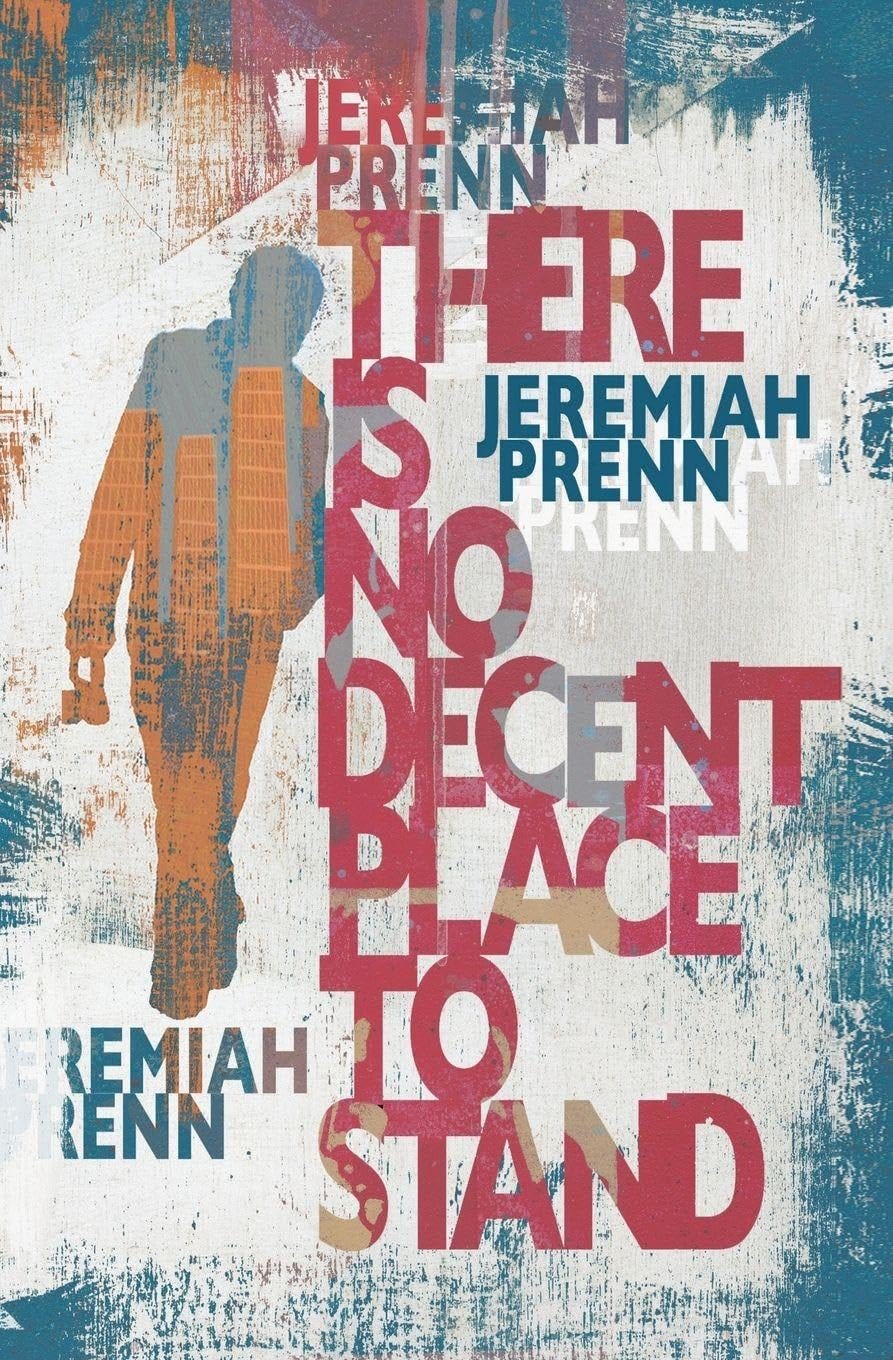
Amidst the swirling and hallucinogenic first-person narratives that make up Jeremiah Prenn’s immersive novel There is No Decent Place to Stand (Galleon Books, 2026), a world of dubiously loyal friendships bound by paranoia, treachery, and fear slowly emerges. The locale is the small European nation of Bunolle, where the currency is the bolle and has the power (despite its precarious standing in the world market) to destroy lives one way or another.
“I’m of the opinion that Prenn displays a controlled mastery of his craft as a storyteller.”
At the centre of our story is British-born Zachary “Throat” Woodbine, an angst-ridden young man. His welfare is of great concern to his friends, who give their sides of the story (as they understand it) in separate chapters devoted to each of them. They are David, a transplanted American who lacks self-confidence in his abilities as a singer and guitar player; Burton, a successful construction entrepreneur until things go very bad; Paloma, a Venezuelan-born sculptress, who like her lover David, is also struggling with her career; Gelle, an elderly store owner and a kind of father-figure or mentor to the others; and Josie, who for a time had been Throat’s love interest until she left him, thus incurring the wrath of the others, becoming something of a pariah.
Bunolleis a monarchy, ruled by an elderly widowed queen. Her son, the conniving bad apple Flenard, is the rightful heir to the throne and expects to ascend upon his mother’s death. Meanwhile, he is involved in numerous shady deals to acquire property and generally lives a privileged and profligate lifestyle. Although he is legally next in line, he has some unofficial competition for the throne from his cousin Aftan, who is of the opinion that Flenard’s shady dealings pose a security threat to Bunolle, which he uses to justify his own crafty alliances. After the friends have had their say in their subsequent chapters, Flenard and Aftan get to give their sides of things, as do their underlings. Thus, we get a litany of dirty deeds (not always done that cheap) and double-crossings that pull in the aforementioned-friends in various unpleasant ways.
These first-person testaments surge back and forth in time, although if one pays attention a shambolic linearity to the narrative makes itself apparent. What seems to be clear enough is that the inciting incident was when Throat took a photograph of Flenard kissing his mistress, as a joke really, but upon viewing the developed snapshot realized that he had also captured the image of an intelligence agent who had been thought dead. Rather than having Throat punished or thrown into prison, Flenard gives the young man a job as a courier, except, as it turns out, the letters and packages he delivers have dire consequences for those who receive them. Wracked with guilt, Throat periodically disappears from and reappears back in his friends’ lives, with cryptic confessions of doing bad things connected to his job.
Prenn makes an oddly fascinating decision after putting Throat at the centre of most of these first-person narratives. Although, Throat is occasionally quoted in conversations related in these narratives, when it comes time for his own point of view in the final chapter, Prenn lays it out for us in the third person. I’ve thought it over and have concluded that I applaud this choice. By denying his protagonist access to address the reader directly and instead assigning his story to an omniscient narrator, Prenn sets up his hapless hero as being utterly caught up in escalating events and portraying him as a faceless victim wandering helplessly toward his own appointed point of no return. In this way, I’m of the opinion that Prenn displays a controlled mastery of his craft as a storyteller.
The voices of these characters find their own unique cadences, but all share a tendency toward rhythmic repetition, which convey moments of confusion, fear, anger and even humour. It’s a prominent technique that Prenn uses to great effect, such as in this unhinged moment from Burton.
‘I have a face, a face of shit. I have ape arms, hairy ape arms that fall between fat and packed. I’ve made wrong moves. I make wrong moves. I. I. You. You in the word of God, the dictum of a fate outside of your control. In this story. Throat has just left and I don’t know when he’ll be back. That’s one point. Another point is that I’ve spent all my available capital on a minigolf course whose child-size runs are surrounded by too many dinosaurs. All my available capital on a warehouse where sex crimes will undoubtedly be committed. All my available capital on the physical token, the manifestation of the word fuck, an ugly concrete bird whose foundation occupies what once was a section of a much, much unloved park, where condoms and brown-red dry stains (didn’t seem like blood but could’ve been) gave texture to an otherwise unused canvas, some nice adult weathering, even if the weather is fuck.’
Or this opening to Paloma’s chapter
‘I came across on a boat I didn’t like, very nearly the same boat that I came to Europe on, hoping to study art, which pretense embarrasses me, now. Artists despising clichés is itself a cliché, but I do despise the phrase “study art,” and “off to study art.” The phrase kneads my skin into points, points that have no connection, and now I am atomized from my anger. I felt this way upon arrival in Venezuela, atomized, and that was before the anger. Things were strange. I was lost. This was home but it had changed. And I was to learn of something which my family had kept from me.’
One of my favourite examples of a wry exchange is this nifty bit of wordplay between David and Throat.
‘I ignored my own advice about letting people do what they want and asked Throat if he didn’t think this new job of his was moving too fast too hard.
‘“It’s a career.”’
It must be noted that There is No Decent Place to Stand is yet another literary home run for the Moncton-based Galleon Books. While this little outlier of a publisher takes pride in the diversity of the books it puts out – from highly imaginative speculative fiction to screwball sci-fi, from novellas of nightmarish humanity to socially-aware story collections, from intellectually challenging poetry to straight commercial novels. I consider Jeremiah Prenn’s genre-denying, language-driven, hard-edged gem of a novel to be a winning example of the kind of whip-smart, cynically compassionate, roller-coaster read that represents what Galleon does best. Highly recommended.

About the Author
Jeremiah Prenn is the author of The Sieve, which received a recommended review from Kirkus.com. He has had work published in several literary magazines. When not writing, he’s hiking, or regretting that he’s not hiking. Jeremiah lives in Meridian, Idaho.
About the Reviewer
Steven Mayoff is a Canadian novelist, poet, and lyricist living on Prince Edward Island. His most recent book is the revised edition of his poetry collection Swinging Between Water and Stone (Galleon Books, 2025). Upcoming are the novel Poor Man’s Opera to be published by Galleon Books later this year, and the two thematically linked novellas At the Mercy of Our Muses from Lost telegram Press in 2027. His website is www.stevenmayoff.ca
Book Details
Publisher : Galleon Books
Publication date : March 27 2026
Language : English
Print length : 268 pages
ISBN-10 : 199812231X
ISBN-13 : 978-1998122318