


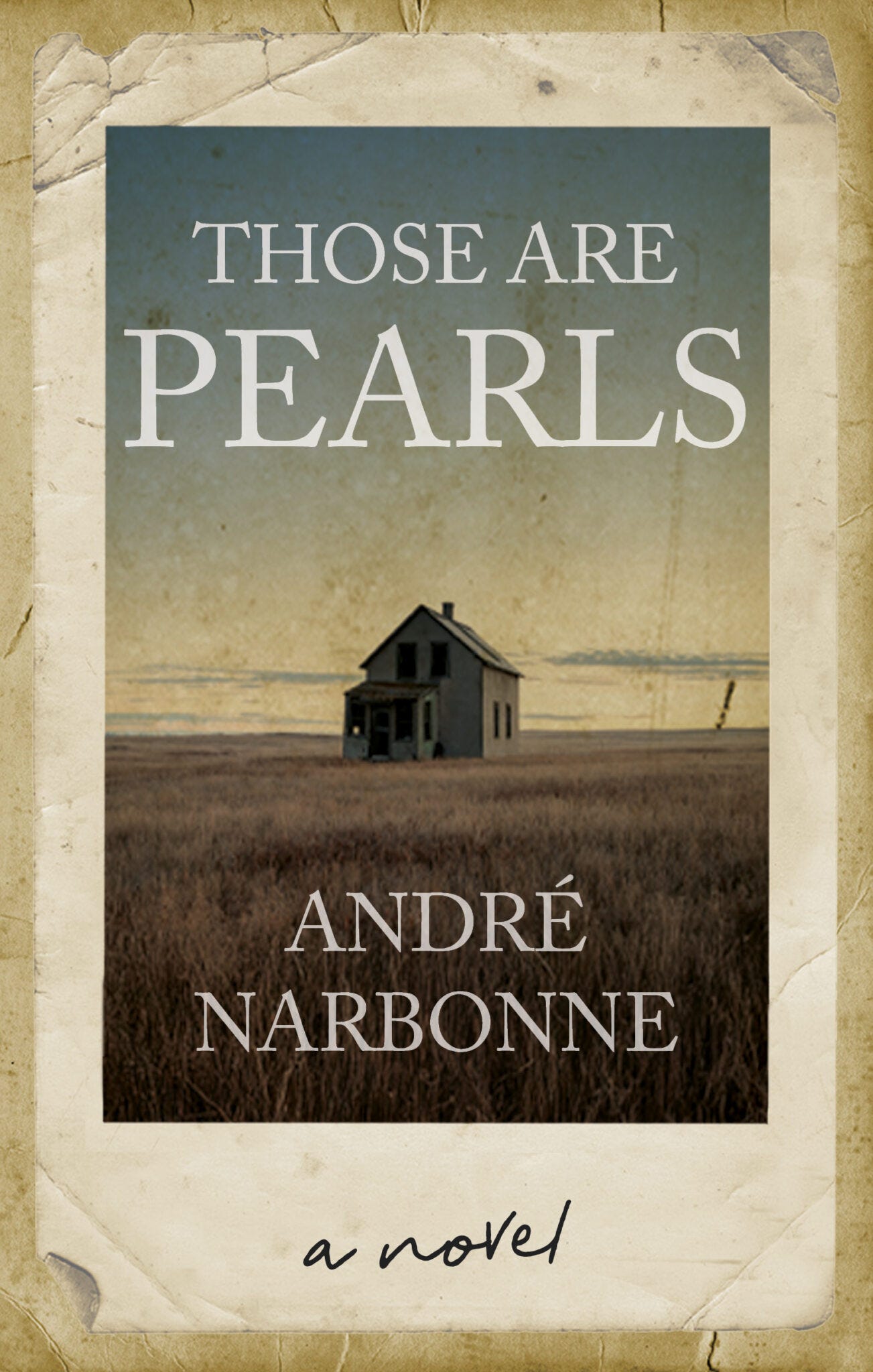
The origins of André Narbonne’s fascinating and bracingly original novel, Those Are Pearls, can be traced to years of research into his own family’s history. The resulting novel has an expansive geographical reach and encapsulates a period from the last few years of the 19th century to 1977.
Narbonne focuses on six primary characters: Harry Short, his wife Margaret Roll, two of their daughters, Ruth and Nan, Ruth’s first husband, Frank Good, and their daughter, Margaret. The narrative is divided into three sections—”Duty,” “Education,” and “Accidents of Necessity”—each of which loosely addresses the theme named in the title while zigzagging through the drama and heartache of one family’s decidedly checkered fortunes.
The story begins in the Transvaal with South African Harry Short among a group of British soldiers taking part in the ill-starred Jameson Raid of 1895. But Harry’s motives for joining a mission meant to protect British interests in the region but which failed spectacularly and eventually led to the 2nd Boer War involve a woman, Margaret, whose affections he’s determined to win and whose father, a wealthy doctor, he wants to impress. Harry—of modest means but an independent thinker who reads poetry—is at heart something of a naïve romantic.
Margaret and Harry marry and settle in Cape Town. But their fortunes take a hit when Harry, a boilermaker by trade, receives a diagnosis (described as “dubious”) and for the sake of his health is advised by a doctor to relocate to a colder climate. It is 1910 when Harry determines the coldest place among the British colonies is Manitoba. Harry travels alone to Canada and establishes a prairie home. Margaret follows (reluctantly) with their children. This is how the family winds up in Winnipeg, where much of the subsequent action is set.
Narbonne’s novel is not structured in a linear fashion. For example, the chapter immediately following the opening chapter where we meet Harry Short (“Harry of Jameson’s Raid (1895)”) is titled “Margaret’s Great Depression.” It is narrated by Margaret Good, daughter of Ruth and Frank. Set in the late 1930s, it introduces a girl whose father has left his wife and children, and who as a result suffers from emotional insecurity. The chapter also makes mention of several important family incidents that later chapters depict in greater detail. Narbonne follows this pattern throughout the book.
“It is in the graceful and intricate intertwining of these threads that the novel’s considerable forward momentum is generated.”
Narbonne’s treatment of his material is unconventional, but at the novel’s end seems entirely appropriate. The narrative is comprised of several plot threads and follows the six primary characters through the ups and downs of major life events, finally delivering them to their various fates. It is in the graceful and intricate intertwining of these threads that the novel’s considerable forward momentum is generated. Narbonne is writing about people whose actions and decisions have repercussions beyond themselves. Like any family, they are inseparable from one another, even in absence, even in death. They dream, they desire, they carry each other in their thoughts. Sometimes they behave badly, and they are not always good to each other. But despite this, or maybe because of it, we want to know more about them.
André Narbonne writes with empathy and without judgment about human weakness. His prose is elegant and detailed and succeeds in swiftly transporting the reader to times and places far outside our experience. In Those Are Pearls, a novel 25 years in the works, he has written an engaging and spirited account of a family swept up in world history whose eccentricities and passions (occasionally misplaced) make them uniquely appealing.

About the Author
André Narbonne is a scholar, writer, and the publisher of Conspiracy Press, based in Windsor, Ontario. His short fiction has been anthologized in Best Canadian Stories, won the FreeFall Literary Contest, the David Adams Richards Prize, and the Atlantic Writing Contest. A first collection, Twelve Miles to Midnight, was shortlisted for the 2017 Danuta Gleed Literary Award. His first novel, Lucien & Olivia, was longlisted for the 2022 Scotiabank Giller Prize.
About the Reviewer
Ian Colford has published three novels and two collections of stories. Evidence was published in 2008 by Porcupine’s Quill and won the Margaret and John Savage First Book Award; Evidence was also shortlisted for the Danuta Gleed Literary Award, the Thomas Head Raddall Atlantic Fiction Award and the ReLit Award. The Crimes of Hector Tomás followed in 2012. Published by Freehand Books of Calgary, it won Trade Book of the Year at the 2013 Alberta Book Publishing Awards. Perfect World was published by Freehand in 2016 and shortlisted in the book design category at the 2017 Alberta Book Publishing Awards. In 2019, A Dark House was published by Nimbus Publishing of Halifax and was shortlisted for the Alistair MacLeod Prize in Short Fiction at the Atlantic Book Awards and the Relit Award. In 2022 The Confessions of Joseph Blanchard won the Guernica Prize and was published by Guernica Editions in November 2023. Witness, a sequel to Evidence, will be published in 2026 by Galleon Books of Moncton, NB. He lives in Halifax, Nova Scotia. More info can be found at www.iancolford.com.
Book Details
Publisher : Palimpsest Press
Publication date : June 15 2026
Language : English
Print length : 200 pages
ISBN-10 : 1997508176
ISBN-13 : 978-1997508175