

Traveling West by C. Lee McKenzie
A Saturday Short for August 2026

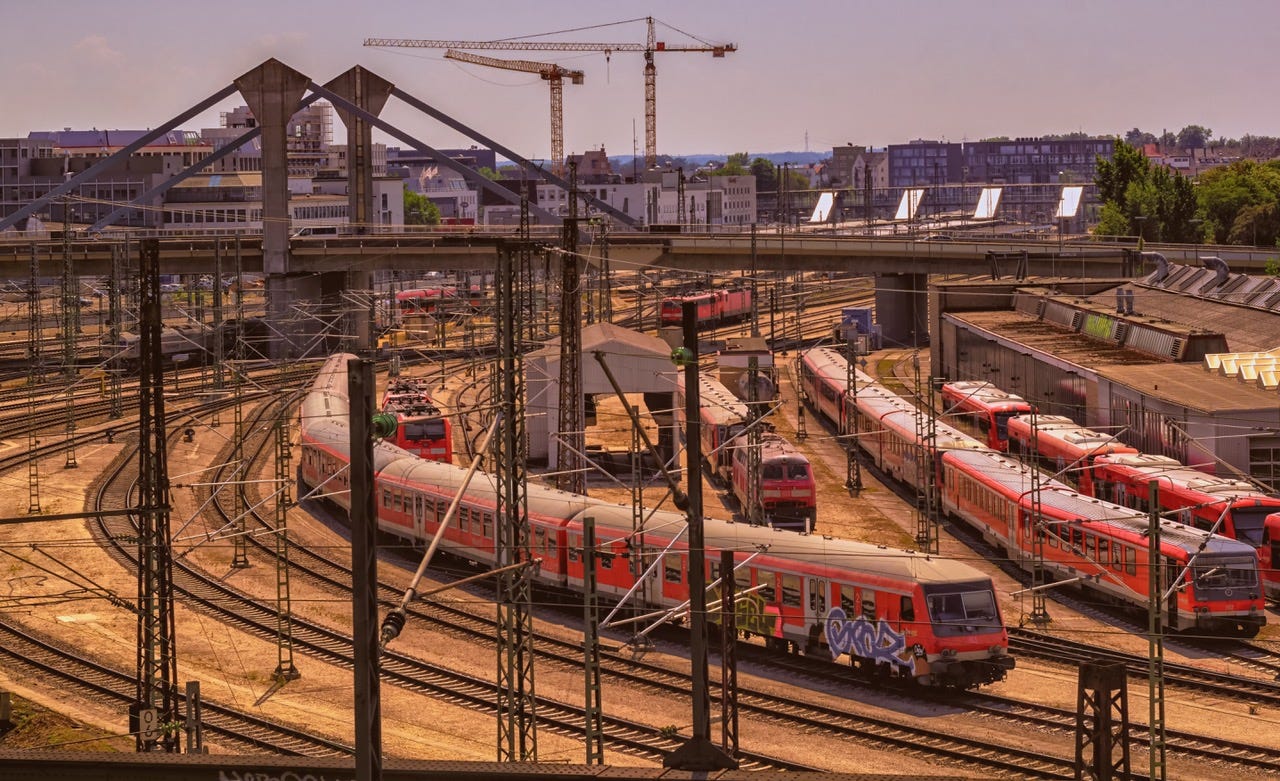
Salman hoisted the Gucci bag over his shoulder. He'd discarded the crude leather case he'd purchased before leaving home and replaced it with this one as his first business in the United States. With one hand firmly grasping the rail, he stepped into the train.
He made his way to a window seat in the car, juggling his ticket and book in his free hand, while keeping a small pillow tucked under his left arm. He had arranged to be early so he could easily secure his window seat and store his belongings before others arrived.
He took care to slip the strap of the Gucci bag from his shoulder, and then, standing tiptoe, lifted it onto the overhead rack.
Settling into his seat, he pushed the pillow behind the small of his back, scooting himself forward so his feet rested comfortably on the floor. Once situated, he opened A Survey of American Literature at the leather bookmark.
The trip from Chicago to San Francisco would take over two days. He planned to read each night until he fell asleep and hoped to wake up refreshed when he reached the school. He didn't want to waste any time once he arrived on campus. Memories of nineteen years wasted already nipped at his heels.
Anyone observing Salman saw a small, dark youth with untended hedgerows for eyebrows. These thickets sprouted across a prominent forehead, casting shadows on his cheeks and jutting over his eyes. The natty Harris tweed jacket, his second item of business after his arrival, sported leather patches at the elbows. In American movies, professors wore these.
He turned to admire his reflection in the window and smiled smugly to himself, recalling the satisfaction he'd felt when he shed the wool coat his brother had loaned him for his journey. He smoothed his ebony hair. It gleamed under the pinpoint light like a high gloss lacquer. His fingers wrapped around the edges of his book with a reverent scholarly grip. Each nail had been carefully trimmed, filed, and massaged into tidy pink tips as if to compensate for the unruly bantam tufts of wiry hair that sprang from his knuckles.
He sat partially hidden behind his literature, sometimes glancing up to notice the people who filed into the car, stowed bags, and took seats around him. His face didn't betray the erratic insect trails that traveled through his stomach, cutting nervous paths of anticipation back and forth, and making it difficult to remember what he had just read.
He'd come thousands of miles, light years when measured in culture, and finally, the year 1960 had arrived, and his childhood dream was within his grasp. He was aboard the California Zephyr, traveling west.
The next person to enter the car jostled his way down the aisle, his duffle bag thumping the seat backs. When the young man reached Salman’s row, the newcomer bumped the shoulder of a woman seated on the aisle. He scuffed a toe of one passenger’s brown Oxford with his oversized tennis shoes. Those already seated made irritated noises. When he reached the seat facing Salman, he tipped his belongings into the overhead rack.
Peering from behind his book, Salman watched as this tall person compressed his height into the space the designer of trains had allotted the average passenger. Salman wondered what it must be like to never have sufficient leg-room, beds always too short, and doorways at one's forehead height.
He studied the new arrival’s untroubled expression. If his size presented problems for him, his face didn't reveal it. Unlike most unusually tall, lean men, this one had a sense of himself, even though he seemed oblivious to the scuffle of chaos he caused when moving among others. His face and his body were open and at ease—accepting, like a child.
Salman felt relieved when he sat near him. With a small clutch of surprise, he realized that this was the first friendly face he'd seen since his family had waved him aboard the departing plane. Salman returned to his reading with renewed concentration.
"Where you heading?"
Salman looked up over the top edge of the page into the young man's quite remarkable gray eyes, now just inches away. He had leaned forward, placing both of his long arms across his knees, and was so close to Salman that as he exhaled, the tufts of hair along Salman's knuckles moved. Salman lowered his book.
"I am bound for the University of San Francisco."
“Wow! USF. Me, too. Hey, where're you from anyways?”
Salman felt disappointed. His effort to sound American hadn't succeeded. "I am from Pakistan."
"Pakistan," the young man repeated as if thinking aloud. "What part of Africa is that in?"
Salman paused for a moment, then, unable to find any way of avoiding a rude reply, he asked simply with a slight tilt of his head, "Africa?"
"Not Africa, huh?" the young man sighed.
"No. More to the east, actually."
"I never was good at geography. Sorry. Hey, my name's Eric. Eric Bowen. What's yours?"
"I am Salman Aziz."
Eric extended a hand and commenced a vigorous handshake that sent tremors down to the soles of Salman's leather boots until his feet rattled against the floor.
"Where you living at the university?"
"I will be living at the dormitory this semester."
"Freeman Hall, by any chance?"
Salman reached into his jacket pocket and retrieved a small notebook with S.A. embossed in gold leaf across the front. He peeled open the cover of the book and ran his index finger down the first page until he found the notation he wanted. "Yes. That is correct. Freeman Hall," Salman said.
“No kidding! Me, too."
They continued to look at each other in silence. Then Eric spoke. "I'm a basketball player."
Salman considered how he should respond and settled for "I will be studying American and English Literature."
Eric groaned and then changed the subject. "Do you like basketball?"
“I am not certain if I do like it."
"You ever seen a game?"
"No. I have not."
"Want to?"
"That would be nice. Yes."
Silence.
"You say you're from…where?”
"Pakistan. Islamabad, Pakistan," Salman said, thinking that this stranger might be more likely to know the capital than Rawalpindi, where his family actually lived.
"This Islamadad. What's it like?"
"Islamabad. B.A.D."
"Bad, huh?"
"Well, yes. In some ways, I suppose you could say it is," Salman said, relieved to be able to say how he felt without his father's stern face to deal with.
They laughed at the joke they had created between themselves, then Salman started to talk about his home to Eric Bowen. He described his father's bookstore. The art books he specialized in, the fine paper, and the excellent binding.
"But what's the country like?" Eric asked.
Salman began with the climate, moved to an encyclopedic description of the mountains and hills of the north, and the desert and dry plains in the south. His words stirred a hot kettle of memories inside his head. While he described the wide boulevards of Islamabad and the domed mosques with their sculpted minarets, in his mind, deformed children and ancient men held out cupped palms and asked for his rupees. The memory of still, dry air crept into his nostrils and filled his lungs with brown dust from parched hills.
While he talked to Eric Bowen about Pakistan's art and tradition, his mind's eye followed a beggar who dragged a toeless foot across a familiar narrow street. It was easy to recall a young Salman Aziz, staring from behind the iron grating at a window of his father's bookstore.
The crippled man limped to within inches of where Salman sat, unable to move, riveted by the horror on the other side of the grating. Salman felt trapped behind the bars that were supposed to offer protection as the beggar raised arms bound with filthy cloth at the point where his hands should have begun. With the eyes of a dead man, he stared at the boy.
Then the beggar rapped one stub against the grating, making a sound like soft lumps of wet newspaper. He extended his other forearm through the grate.
Salman fell back, screaming. His father came then and shouted at the man to go away. The beggar turned and limped down the street. Salman stared after him and the starving dogs that tracked the man's path, their noses keen to the scent of decay.
That was the day young Salman Aziz began planning his escape to America.
"Why do you want to hear of my country?" he growled in sudden irritation.
"Just making conversation. That's all," Eric said, drawing away and leaning back.
The passengers near them glanced sideways and shifted uneasily.
“I…I am very sorry," Salman said quietly, leaning toward Eric in confidence. "It is sometimes difficult for me to speak about my country. I am very homesick, you see," he lied.
"Sorry. I’ve never been out of Illinois. Guess I didn't understand."
"Please tell me about your game of basketball."
Eric grinned. "Been playing my whole life. Hell, basketball is my life, Sal. Couldn't live without it. When I get done at the university, I'm going pro."
"Pro?"
"Professional. You know, Lakers or something. Make tons of money."
"How tall are you, Mr. Eric Bowen?"
"Six eight."
Salman calculated that this man was exactly sixteen inches taller himself. "You are very tall," he said, stating the obvious.
"Yeah."
"Mr.—"
"Just Eric."
Both fell silent. Eric yawned. The man next to Salman coughed and opened a magazine. Salman picked lint from the front of his slacks and let his gaze wander across to the woman who sat next to Eric.
She had entered the car, found a seat, and immediately allowed her head to drop back against the headrest. Her eyes were closed, her body sprawled like a discarded doll. Her face was pale, and her hair clung to her small head, parting over her ears, coating her shoulders. Her hair was pale, too. She reminded Salman of clear broth diluted by far too much water. For a moment, he thought of the rich brown skin of his sister and mother. There were a few things he might miss here.
“What are you staring at?" she asked, startling Salmon because he had thought she was asleep. She opened her eyes and fixed Salmon in blue ice. He didn't reply, but turned again to his book.
"Say, Sal," Eric said. "You got a girl back home?"
"No."
"Want me to set something up when we get to the university? I got some numbers already."
"I don't know. I—"
"Hey, don't worry. I got their names from my cousin, and he's cool.”
"It's not that, Eric. It’s…” Salman glanced at the others seated near. Now he leaned across to Eric and whispered, "I do not feel comfortable with women …American women."
"Why?" Eric whispered back.
"I think they do not understand men from Pakistan."
"Hey, men are men, Sal."
"Perhaps. But—"
"Say, if it's the height stuff, buddy, don't give it another thought. There's lots a honeys just your size."
Salman smiled and shook his head. Then, with the suggestion of a leer, he said, "I prefer tall… honeys."
Eric laughed: "You're something else, Sal."
The train sped west. Eric pushed himself back into his narrow seat and tried to draw his legs close. The man next to Salman began breathing in deep, regular breaths that exploded from his nose and mouth. The girl covered her diluted self with a parka and sealed her eyes again behind lids painted darker and curiously more human colors than the rest of her.
Salman adjusted his pillow to fit between his head and the window, and concentrated on the steady sound of the wheels beneath him.
Salman's dreams click-clacked into his head and returned him to his tenth year and his father's store, where he sat in secret behind his favorite shelf. Silently, and with great care, he opened the oversized book across his lap. The color photograph of the northwestern forest in California embraced him. It gathered him up and placed him on the damp earth floor. He moved in the motion of a dream, the fragrant pines brushing against his face, then, lying back, he looked into the heavens through the giant tops of the legendary redwoods.
The pages turned, and he strolled down the broad sidewalks of New York, along the Great Lakes, and across the green expanses of midwestern park lawns. The cities sparkled. The land felt alive under his feet.
“Salman," his father's voice commanded, and Salman hurriedly slipped the book into its slot on the shelf.
The sudden silence outside the dream woke Salman. The train wasn't moving. He looked through the window and saw they hadn’t left the city behind yet. He stood, pulled on his boots, and made his way to the door of the compartment.
"Why are we stopped?" he asked a conductor.
"Trouble up the line. Be about fifteen minutes."
Salman walked to the end of the car. He hesitated and then stepped off the train into a day of half-light. Shadows stretched over the world, but once long and lean, they now grew squat as they inched back and folded into themselves.
In the distance, Chicago’s neon windows sparkled in a galaxy of white lights. It was more beautiful than Salman ever expected. For years, he had stood at his window and, while his family sent prayers to the east, he clenched his eyes and prayed to a western god.
"Let me escape!" he would beg. "Please!" And now he stood at the edge of that new world he'd so fervently prayed for all those years. He stepped around pools of iridescent water cupped in small depressions near the tracks. Oily blue-green and silver shimmered under the last light in the sky.
He moved slowly, teetering with arms outstretched for balance. A few feet ahead of him, an abandoned shed tilted dangerously off-center. Boards once nailed in crosses over the windows and door now hung loose at one end and swung like broken arms in the wind. A rat slipped silently along the shed's perimeter, trailing a long naked tail over the dirt.
From inside the shed came a thud, a muffled groan, and the sound of feet retreating into the distance. He should return to the train. His instincts warned that this was no place for a stroll, and yet he was compelled to move forward and into the shed. He pushed on the door and looked down into eyes as pain-filled as the beggar who once stood staring at a younger Salman through the bars of his father’s bookstore window. Blood trickled from a head wound and spread in a thick, dark patch across the floorboards. The rat waited hunched in the far corner, silent like a watcher for the dead.
Salman retreated. His throat burned with his own bile, and he swallowed hard to turn the hot tide of vomit. It was too late. He dropped to his knees, heaving.
"Sal. Hey, buddy! You sick?" Eric Bowen shoved a wad of tissues into Salman's hand. "Here, use this."
“Thank…thank you, Eric," Salman managed, wiping his mouth and standing.
"Let's get you back on the train, man."
"Yes. Please."
Salman allowed Eric to lead him back to the train, much like he once allowed his father to lead him through the streets of Rawalpindi as a child. "Thank you for coming to find me, Eric," he said, returning to his seat and not looking up as he spoke. He could feel the girl's eyes fixed on him from beneath her sheer eyelids. He accepted the water Eric offered and rested his head on his pillow. The train lurched, picked up speed, and resumed its journey west.
"You better, Sal?" Eric asked, then, pointing to Salman's dirt-stained slacks, said, “You kind of messed those up.”
Salman brushed at the dirt, smearing it. “Thank you. I am better." He remained quiet for some time while Eric sat gazing out the window.
"Sal. You know you never did tell me. Where is Pakistan?"
Salman raised his eyes and smiled sadly. "Actually, Eric, Pakistan is just outside of Chicago."


About the Author
C. Lee McKenzie is a native Californian who grew up in many different places before settling in the Santa Cruz Mountains. She writes, gardens, hikes, practices yoga, and travels whenever she can. She also loves to cook—and especially loves to eat.
Her young adult crossover novels explore the contemporary issues teens face in everyday life. Her Evernight Teen publication, Double Negative, was named one of the Top Ten Young Adult Books of 2020, and her novel Shattered was a finalist for the 2022 Indie Book Award. She recently published her first young adult paranormal novel, Rattlesnake, and will follow it with That Moonwater Witch in May 2026.
She is currently serializing short fiction on Substack in a series titled A Weekly Dose of Fiction. Connect with her at C. Lee McKenzie on Substack.