

Unequivocal Magic by Alex Bertram
Sarah Bernhardt and the Journey of a Portrait

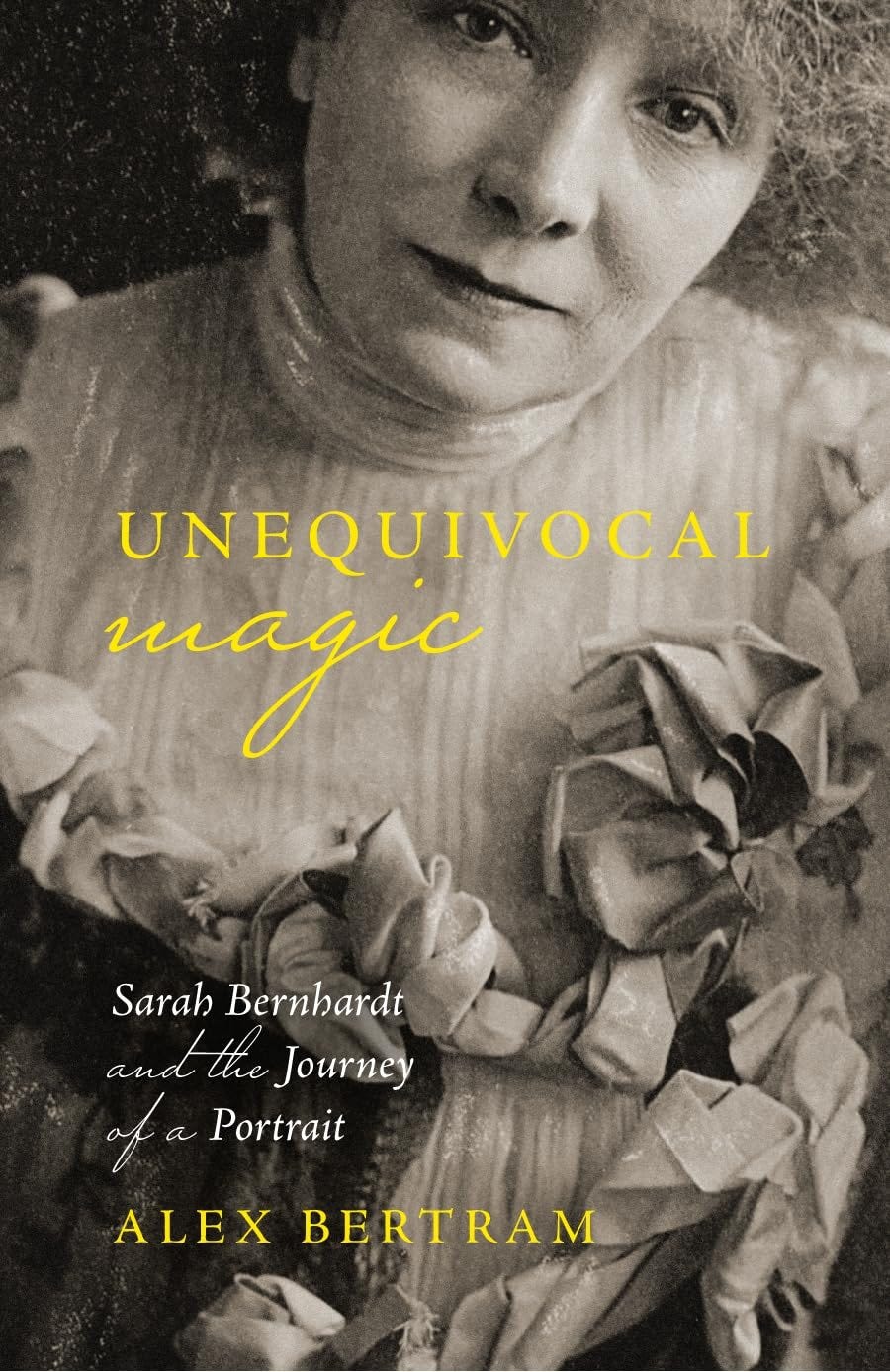
Alex Bertram’s Unequivocal Magic traces the journey of Sarah Bernhardt’s 1910 portrait, and along the way she includes a history of photography and phenomenology. Although Bernhardt may be the protagonist of this story, she shares the stage with her Australian photographer H. Walter Barnett, as well as with Bertram herself who engages in dialogue with her subjects. Her French phenomenology not only appears in her subjective experience as narrator but also derives from such philosophers as Maurice Merleau-Ponty, Henri Bergson, Gaston Bachelard, Roland Barthes, Walter Benjamin, and John Berger. That concatenation of Bertram, Barnett, and Bernhardt joins with all the other B’s in a multi-frame approach.
Her “Preface” indicates that this book has its origin in a creative writing doctorate: “My reasons for choosing this portrait and all the pictures in the book were very much based on instinct. I trusted my first impressions and chose accordingly…. I adopted a reflexive first-person account.” Fortunately, her instincts and impressions are sound and stimulating. She begins in Barnett’s studio in London, 1910, and in her daydreams and quest she identifies with A.S. Byatt’s Roland in Possession. Exploring the history of Knightsbridge, she uncovers the River Westbourne, a tributary of the Thames and one of London’s lost rivers. Barnett’s glass studio leads to a discussion of the history of glass linked to the development of photography, the repeal of window taxes, the rise of the railway, and the Crystal Palace Exhibition of 1851.
“Unequivocal Magic may be an intimate and intricate collage of Bernhardt, Barnett, and Bertram in which the actress’s portrait forms a palimpsest between past and present where actress, photographer, and writer journey phenomenologically.”
Bertram bolsters her historic perspective with Isobel Armstrong’s scholarly book, Victorian Glassworlds, Glass Culture and the Imagination 1830-1880. She acknowledges Armstrong in her “Bibliographic Essay” which further emphasizes her phenomenological approach: “In works of creative nonfiction, such as this, the evidence of the creative process is built into the narrative through the use of natural language and the author’s self-aware point of view.” Although the author’s natural language and self-awareness are evident in her text, one wonders what unnatural language would look like. To justify her methodology, she adopts “the approach used by one of her sources, the Cherokee scholar David Heath Justice, “in their work Why Indigenous Literature Matters.” That approach is more mindful, ethical, and inclusive in its citational practice, as opposed to a more traditional bibliographic entry with its objective status.
In other words, Bertram takes her reader along for the ride at every stage of her exploration. Immersing herself and her reader in her London quest, she walks and catches her reflection in a shop window. “But I also see that I am not the only one there; the cyclist behind me and a woman with an umbrella are present too. All our images, and those before us, momentarily collide to form an intricate collage.” Unequivocal Magic may be an intimate and intricate collage of Bernhardt, Barnett, and Bertram in which the actress’s portrait forms a palimpsest between past and present where actress, photographer, and writer journey phenomenologically. This experiential quest includes French sources mentioned above as well as Francis Ponge.
So much about Bernhardt is elusive, and photos reflect that elusiveness. In the first one around 1880 she is in a travelling costume, her left hand clasping a belt while her right holds a handkerchief. Her hair stands high, her face alluring and evasive, distant even in a close-up, for the actress and her roles are inseparable. Bertram frames her in a historic context of Proust and Bergson. Of her travels the actress writes: “I cling for a second to what, and then I fling myself headlong into what is to be…. I adore what is to be without ever seeking to know about it.” She suffers from stage fright. Another portrait in London’s National Portrait Gallery shows her seated, her head tilted in bright light with a wistful gaze, her hand clutching the chair, a floral pattern shielding her torso.
Bertram also includes Sir Joshua Reynolds’ eighteenth-century painting, “Sarah Siddon as the Tragic Muse,” before commenting on Bernhardt’s playing the role of Hamlet. She also includes a section on Ethel Arnold who became Barnett’s business partner in 1914 and travelled to St. Louis, Missouri to lecture on women’s suffrage. In addition, there is a section on Josephine Baker. In passing, we also learn that German troops burned books in Louvain, Belgium as early as 1914. The Japanese art of kintsugi also makes its way into these pages. All in all, Bertram presents her reader with an unequivocal kind of magic before she disappears into the crowd like so many latter-day flâneurs of myth and optical illusions.

About the Author
Alex Bertram is a writer and educator. She has worked for trade and academic publishers in Melbourne and London and holds a PhD in Creative Writing. Alex lives in Victoria, BC, and works as a writing instructor at the University of Victoria and Simon Fraser University in Vancouver.
About the Reviewer
Michael Greenstein is a retired professor of English (Université de Sherbrooke). He is the author of Third Solitudes: Tradition and Discontinuity in Jewish-Canadian Literature and has published extensively on Victorian, Canadian, and American Jewish literature.
He has published 250 essays and reviews in books and journals across Canada, the United States, and Europe.
Book Details
Publisher : Wilfrid Laurier University Press
Publication date : April 28 2026
Language : English
Print length : 216 pages
ISBN-10 : 177112718X
ISBN-13 : 978-1771127189
 | A guest post by
|
This book looks fascinating! I love the title and really appreciate the review. Definitely on my list.
On a personal note, for years I kept a portrait of Sarah Bernhardt on my wall, inspired by the thought of her performances. In my family (fun fact), we have a story of her. My great-grandfather, who drove a train out of London, Ontario, once delivered the actress to a "farewell tour" destination. According to my grandmother, Bernhardt made a point of meeting him after they'd arrived, shaking his hand, and telling him it was one of the smoothest train rides she'd ever had. What a person she must have been.
Fascinating indeed, Robin.
There is a very good restaurant in Toronto called Bernhardt’s.