

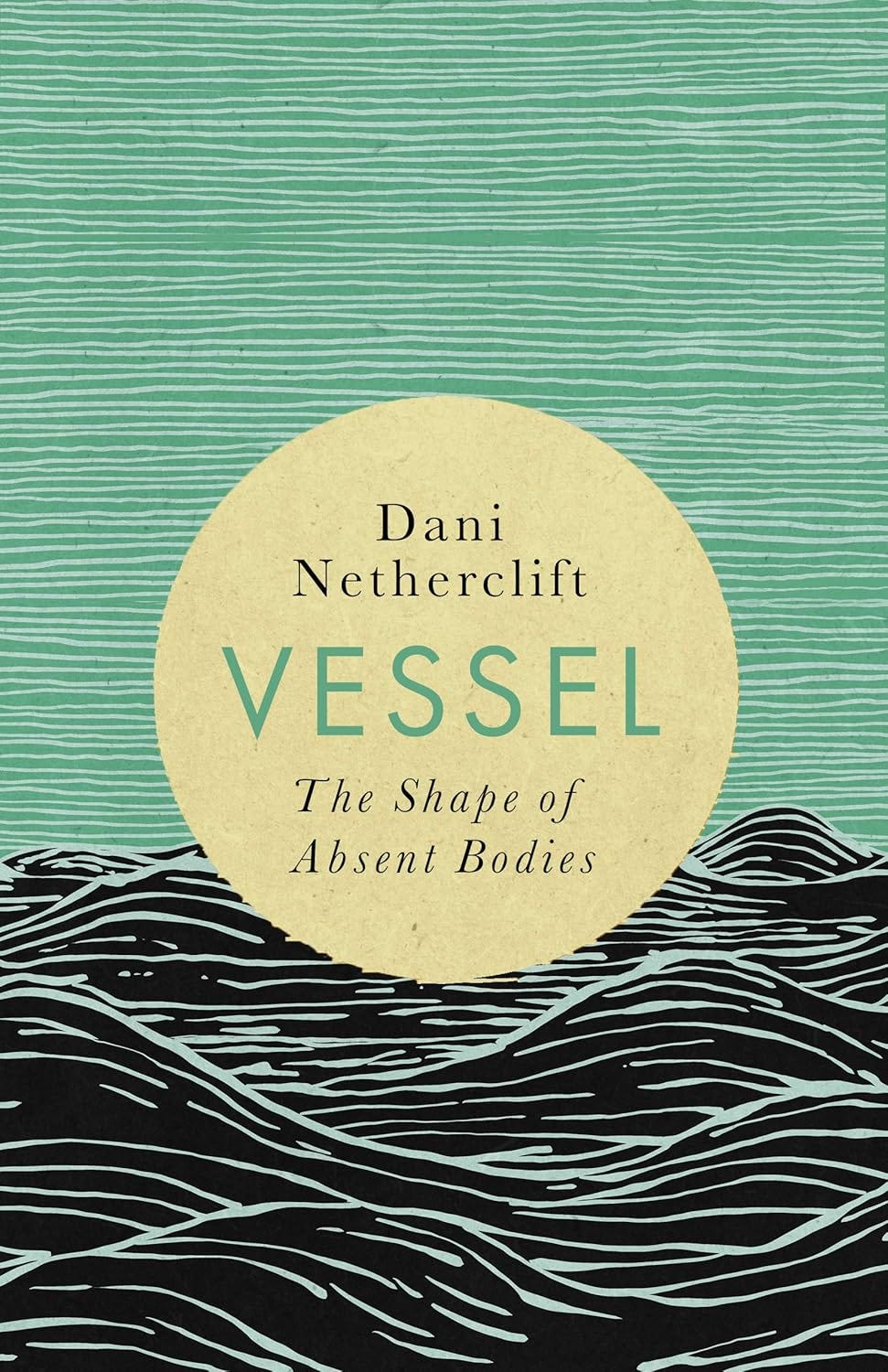
Vessel: The Shape of Absent Bodies by Dani Netherclift
Reviewed by Bryn Robinson

The body of a drowned man is not a poem,
and yet his body can be transformed into
words...
Revisiting the nature of life and death in tidal cycles, Dani Netherclift provides the reader with a thoughtful, elegiac meditation on a family tragedy in Vessel: The Shape of Absent Bodies.
Lest one think that a lyrical essay anchored in witnessing the drowning deaths of her father and brother when she was barely an adult, is too sombre a read for any time of year (let alone the post-holiday North American release that is scheduled), Netherclift’s approach keeps her explorations of death and what endures from being too heavy. She moves through details in a (somewhat) chronological order, only to reexamine and reconcile facets of the experience with new context, much in the circumfluent way anyone does when trying to make sense of a senseless event (“I stand on the sharp grass of the channel bank as at an autopsy table, returning again and again…”). She integrates clippings from the papers - articles about her family’s deaths or other similar losses at the Waranga Basin - and reconciles their inaccuracies with other observers’ accounts of the time before, during, and after the drownings take place. Grief is not linear, and her writing - similar to a stream of consciousness - illustrates this well.
Central to Netherclift’s exploration of the events of January 2, 1993, is her thesis that our bodies are only ever mere vessels in the waters of life, “…for everything we have to lose.” In fact, she wonders whether the bodies recovered in the basin afterwards are even belonging to her dad or her brother; who can claim ownership once the person is emptied of the pitcher and transitions from “subject” to “object”, to become only “…visual echoes of what used to be”. She reflects, too, on the ephemera that may provide clues to the life once lived - a set of pencils, a diary, a butcher’s apron - but which are ultimately inadequate. [At one point, she notes that these are merely “homeopathic distillations”, which is a fascinating image. The more dilute the solution (time) becomes, does the medicine within (love) gain strength?] Most effectively, she punctuates this point by scattering images of fragile envelopes that once housed letters addressed to her great-grandmother during World War I. The content of the letters - addressed to the place from which the fated party departed on their last day - are never shared but are irrelevant; rather, their place is to illustrate the fragility of the vessels that hold life can be, and how the memories, images, and emotions inside are not knowable by looking at their containers.
A corpse is not a poem, but a collection of
words is all I have, to describe that absence,
no matter how abject.
While she notes the importance of viewing the physical corpse in providing comfort and closure to the grieving (“…this act of viewing was pivotal in his healing process, that the space for horror in his imagination that would have existed without it would have destroyed him.”), I wonder whether the unknowable of those final moments still leaves too much “space for horror”. As such, her essay asks difficult questions and gives space to intrusive thoughts as she wonders what their final moments were truly like (“People don’t just disappear. [Unknowable] things happen to them before that.”), before acknowledging that the experience can only ever be really known to two individuals (“What is lost, unfathomable, is not only my father and brother, but what their deaths were like for them.”).
Nonetheless, by submerging herself (and by invitation, us) in the details of this pivotal day in her life, Netherclift presents a vessel for an artefact to be gently held. Which grief, and love, certainly are.

About the Author
Dani Netherclift is a poet and essayist living and writing on unceded Taungurung Country in Australia. Dani has a PhD in Creative Writing with a specialization in the elegiac lyric essay. Her shorter essays and poems have been widely published in Australia in literary journals and anthologies. She has won or been otherwise commended in multiple writing competitions.
About the Reviewer
Bryn Robinson (she/her) lives in New Brunswick, Canada, where she uses her PhD in experimental psychology to help her support mental health research in the province. She prefers contemporary fiction, narrative non-fiction, graphic novels and poetry that is emotional, reflective, and if it can do it with humour, all the better. Bryn also writes on Campfire Notebook, where she regularly features original poetry. When not reading, she’s searching for birds in the New Brunswick forests and seascapes, camera in hand.
Book Details
Publisher : Assembly Press (January 13, 2026)
Language : English
Paperback : 184 pages
ISBN : 9781998336258