

Vidal: A Graphic Novel by Danila Botha
A Guest Review by Natalie Fingerhut

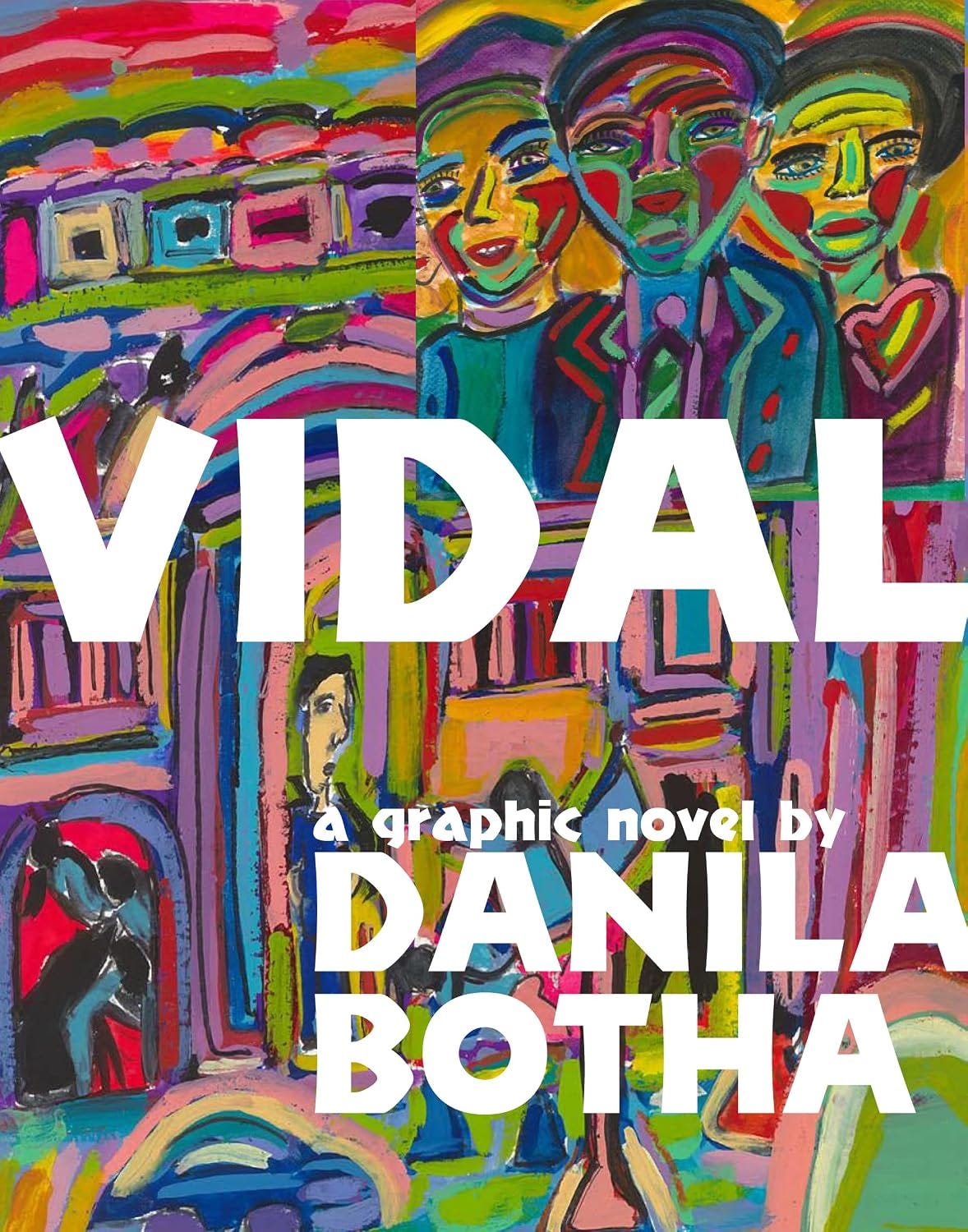
So searingly beautiful.
There are many unique aspects of Danila Botha’s Vidal, her first graphic novel from the focus on a Sephardi Holocaust survivor, the source material for the graphic novel, the intense colours.
From the first page, the reader is confronted with an oddity: Vidal, the subject of the graphic novel. speaks Hebrew and Arabic. This is not the Yiddish that readers of Holocaust literature are familiar with. We learn that Vidal is from Tiberius in British Mandate Palestine. How does he get from Tiberius to Auschwitz?
More questions come to mind. We know from the dedication that Vidal is the author’s great uncle. Yet, the introductory essay is written by Vidal’s daughters. So from whose perspective is this written? It turns out that it is from Vidal himself and his painting, drawings, notebooks, and sketchbooks that he gifted to his daughters.
The art is astonishing – so different from Maus or Persepolis. Covering the whole page, bleeding into the margins, the colour is everywhere, fearless, like what we image the author to be.
The colour turns the words into tastes and smells. Vidal’s world, in Botha’s interpretation, is bright and wild like the man himself. Until the Nazis show up, and then we see the familiar black, red, and white. The imagery drops the reader back to reality better than any words.
Vidal himself is flawed and that is important. We have a tendency to turn Holocaust survivors into saints but that does a disservice to them. Vidal is not an angel, and it is OK to say so. I mean, who could resist a blue-haired, blue-glasses femme fatale.
A few quibbles: for the non-Jewish reader, words like “shacharit” “daven” could have been in a glossary. I appreciate the commitment to Vidal’s “voice” but foreign languages often trip up readers.
I think the lack of historical context is also a missed opportunity. More dates would have been helpful to establish the historical timeline. A translation of the document dated July 4, 1942 would have given the reader a sample of primary source material. The scene involving the mosque is fascinating. Did all mosques hide Jews? How interesting would that tidbit be given our current moment.
There are also some punctuation errors that confuse the dialogue. A good proofread would have been helpful.
Unlike other graphic novels that end abruptly, Vidal ends neatly which is greatly appreciated. I understand the need to be true to experience but the reader, especially young readers, comes away with confusion when the ending is incomplete.
Vidal is a good Holocaust story but it is the art and Sephardic focus that really separates it from other similar books.

About the Author
Danila Botha is the critically acclaimed author of the short story collections Got No Secrets and the Trillium Book Award, Vine Awards, and ReLit Awards finalist For All the Men (and Some of the Women) I’ve Known. Her new collection, Things that Cause Inappropriate Happiness, was published by Guernica Editions in April 2024. Vidal is her debut graphic novel. She lives in Toronto.
About the Reviewer
Natalie Fingerhut had a 20-year career in publishing that included a list of Holocaust graphic novels.
Book Details
Publisher : At Bay Press
Publication date : May 25 2026
Language : English
Print length : 120 pages
ISBN-10 : 1998779920
ISBN-13 : 978-1998779925