

Walrus: The Remarkable Life of Eco-Warrior David Garrick by Catherine Marie Gilbert
Reviewed by Dawn Macdonald

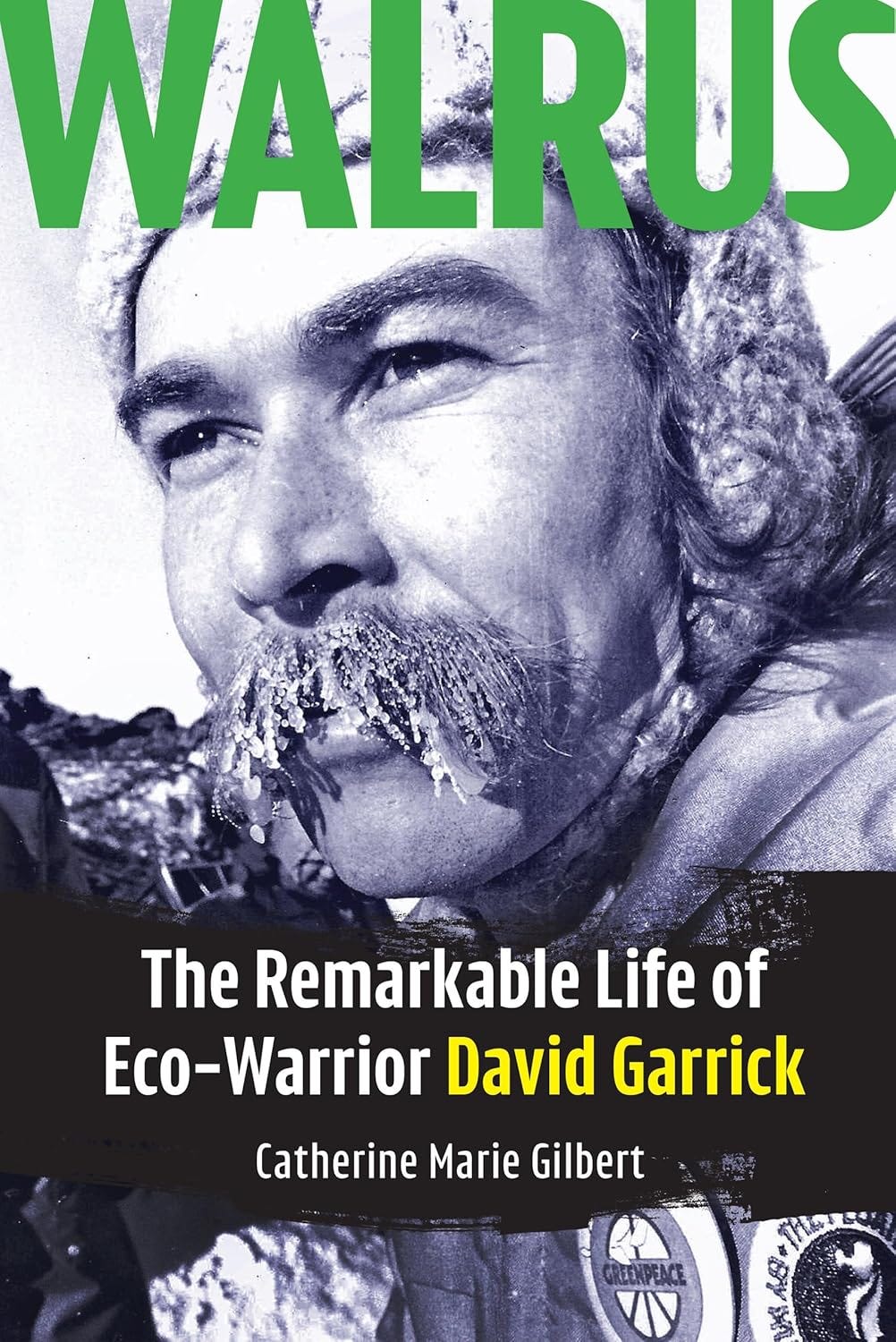
As a young activist working out of the Environmental Youth Alliance house in Vancouver in the summer of 1991, I remember hearing a lot about Paul Watson, formerly of Greenpeace, whose vessel Sea Shepherd II was out there intercepting and at times ramming into the driftnet fishing boats that posed a threat to dolphins and other “non-target” ocean species. There was debate about his methods, but general agreement that this kind of personal dedication was, in itself, pretty cool. The name of David Garrick also rings a bell, but I’d be hard put to place it exactly. During that period, Garrick would have been working in Ottawa, and I wouldn’t have met him, even though he’d been a huge presence in the British Columbia environmental movement before and after. It seems he was always a little bit behind the scenes, though, and many people hadn’t heard of him, or had, but then forgot about him, until Catherine Marie Gilbert undertook to tell his story in her new book Walrus: The Remarkable Life of Eco-Warrior David Garrick.
“Before his death in 2023 at the age of 76, he’d granted Gilbert access to this collection of handwritten material, and the two of them had engaged in extended conversations about his life.”
Garrick, it turns out, was involved in many of the iconic “direct action” campaigns of the 1970s and 1980s. He was out there in the ocean going after Russian whalers, and on the ice getting in the way of the seal hunt. He often took on the role of “chronicler,” keeping copious notes on events as they unfolded, and writing dispatches for The Georgia Straight under his byline of “Walrus Oakenbough.” Over his lifetime, he amassed hundreds of notebooks filled with his observations and musings. Before his death in 2023 at the age of 76, he’d granted Gilbert access to this collection of handwritten material, and the two of them had engaged in extended conversations about his life. Walrus thus lands somewhere between biography and “as told to” autobiography. The book tells Garrick’s story from Garrick’s perspective, presenting his version of events—which doesn’t always exactly line up with other sources.
Garrick, like many in the counterculture, started life from a position of relative advantage. His father worked as an infectious disease specialist with diplomatic postings under the auspices of the World Health Organization, and a portion of Garrick’s youth was spent living in Panama’s Canal Zone. The contrast between his family’s privileges and surrounding conditions sensitized his nascent social conscience. As an adult, he would turn his back on financial stability and focus his energies fully on “the movement.” Vancouver was something of an epicentre for environmental and peace activism in the 1970s, and Garrick soon found his way there. The counterculture scene was vibrant and welcoming to like-minded newcomers, offering a chance to experiment with communal living and collective action.
As I can also attest from my time in the environmental movement, activist organizations are prone to internal rifts stemming from personality conflicts and/or differences in philosophy. A lot of the energy of groups like Greenpeace in the 1970s and 80s was directed towards saving individual animals—whales, seals, dolphins, wolves—from hunters, fishers, and government “cull” programs. This put them at odds with Indigenous communities and other local residents defending their traditional harvesting and mode of living. Garrick’s stated interest in working more closely with Indigenous groups was often sidelined by other movement members, who felt that nothing should stand in the way of stopping the kill.
Gilbert offers a wealth of detail about the various campaigns with which Garrick was involved, filling in a rich history of activism in and around British Columbia. Because her text is so heavily inflected through David Garrick’s telling of these events, it’s difficult at times to know how much to trust the accuracy of the story, particularly at points where Garrick may have been in conflict with others or where his memory departs from existing texts authored by some of these other players.
One area where I’d have liked a more complete picture is in regard to Garrick’s children and their mother, Taeko Miwa. We’re told that Miwa was displeased with Garrick’s workaholism and failure to contribute equally to childcare. At some point, she took the children to Japan for “a visit” and stayed there for fifteen years. These facts are delivered, but then the text just moves along to the next phase of Garrick’s environmentalist work. The book’s acknowledgements section indicates that the grown children cooperated in its publication, and perhaps they didn’t want more of their story to be told, but it feels like there is a heck of lot that’s buried between the lines.
Garrick spent most of his elder years living on Hanson Island in the Queen Charlottes, in a semi-permanent camp with shelter, a garden, and a solar array. He continued to keep notebooks during this time, logging the day’s activities and recording mystical experiences, like one in which a red cedar began to emit light and revealed itself to him as a magical portal.
The picture of Garrick that emerges from the pages of Walrus is at once singular and archetypal. His individuality shines through, and one can see why Gilbert was so charmed in her conversations with this man. At the same time, not having known him myself, I feel that I’ve known plenty of people very much like him. He’s representative of a period when it felt like the counterculture really had a shot at overturning reality, remaking society, and ushering in a New Age of peace and wellbeing and the occasional mushroom-enhanced walk between dimensions. His story is worth preserving, not just because it maps a timeline of significant events, but for the man himself.

About the Author
Catherine Marie Gilbert is an award-winning Vancouver Island author, photographer, historian and lecturer with a passionate interest in life on the British Columbia coast. She has written two books of BC history: Yorke Island and the Uncertain War, Defending Canada's Western Coast during WWII (2012) and A Journey Back to Nature, a History of Strathcona Provincial Park (2021), which was a BC Bestseller and won the Lieutenant Governor's Finalist Award for Historical Writing. Catherine has a Master's degree in public history from the University of Victoria and has taught Canadian history at North Island College in the Comox Valley. She frequently lectures on British Columbia coastal history even taking her stories on the road and out to sea, escorting tour groups to Strathcona Park and Nootka Sound. Catherine works at the Alert Bay Library & Museum and keeps an office in Campbell River. www.catherinegilbert.ca
About the Reviewer
Dawn Macdonald lives in Whitehorse, Yukon, where she grew up without electricity or running water. She won the 2025 Canadian First Book Prize for her poetry collection Northerny. She posts weekly on Reviews of Books I Got for Free or Cheap (on Substack), as well as reviews for journals and The Seaboard Review of Books.
Book Details
Publisher : Ronsdale Press
Publication date : April 27 2026
Language : English
Print length : 284 pages
ISBN-10 : 1553807413
ISBN-13 : 978-1553807414
 | A guest post by
|