


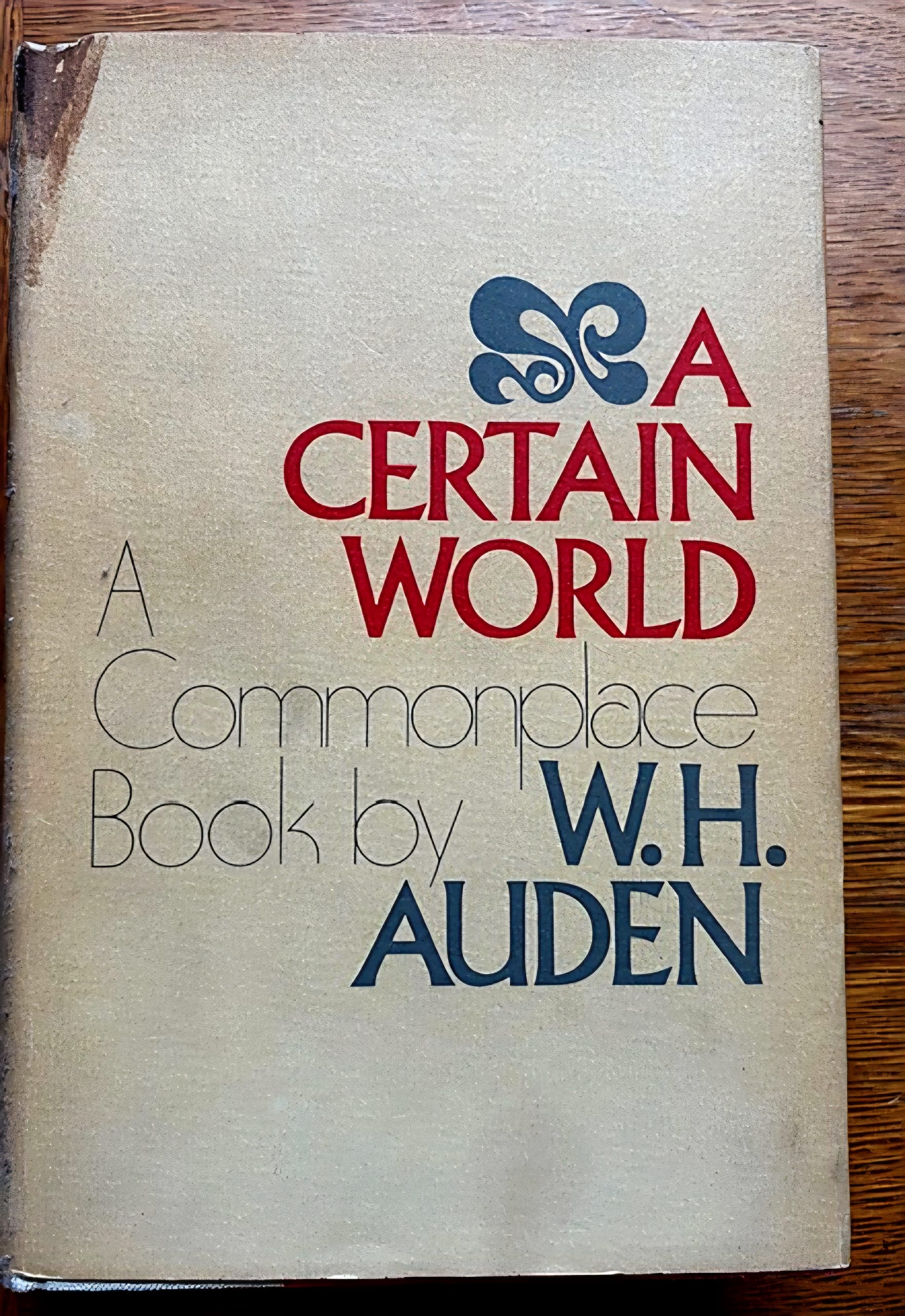
One of the secondhand books in my library that I treasure most is W. H. Auden’s A Certain World: A Commonplace Book (A William Cole Book, Viking Press, 1970). Though hardly common nowadays, commonplace books have been kept by many writers over the centuries, among them John Milton, Samuel Taylor Coleridge, George Eliot, Ralph Waldo Emerson, Virginia Woolf, E. M. Forster (at Undercover Books, the Cleveland, Ohio bookstore I ran at the beginning of my career, we stocked a scholarly facsimile edition of Forster’s commonplace book published by Scolar Press) and C.S. Lewis, as well as Auden (1907-73), whose profound poem “September 1, 1939” is also a personal favorite. Commonplace books are often very personal assemblages, and as such are seldom published later; Auden’s is an exception. They may be kept for decades, even over a lifetime, and are apt to contain adages, aphorisms, bits of wisdom, maxims, quotations, clippings, lists, poems, even recipes.
A Certain World —which I also blogged about on this site back in 2022*—is arranged alphabetically by category, with dozens of headings, e. g., Hell, Home, Humor, Marriage, and Neighbors. Under “Money” is this gem, a translation of a Yiddish proverb: “If the rich could hire other people to die for them, the poor could make a comfortable living.”
A Wikipedia entry reports that the origin of the term “commonplace book” goes back to Latin and Greek, and that in Aristotle’s time, a discrete nugget of knowledge was known as a “commonplace.” It strikes me that my home library is in some ways a kind of commonplace book, with a wealth of wisdom secreted in the pages of the scores of volumes I’ve accumulated over the years, waiting to be discovered—and rediscovered, since I savor rereading my favorite books, something I’ve been doing today with A Certain World. I cannot remember where I found my copy of Auden’s book, nor whether I was living in Cleveland or New York City when I bought it; it might have been New Hampshire, as I bought many good books at used bookstores during my college days at Franconia College in New Hampshire in the 1970s, though I wasn’t aware of the term commonplace book until I became familiar with it at Undercover Books post-college due to the E. M. Forster example mentioned above. Wherever I got it, I’m very glad I did. It doesn’t seem to be in print currently, neither in the US nor the UK. Right now, there’s a handful of copies of it for sale on used book sites, ranging in price from $41 to $125. One aspect of the book that I’d like to learn about is the Viking editor, William Cole, who had an imprint in his name. The hardcover edition that I have is a handsome volume with a crisp dust jacket and stunning red endpapers which can be seen in the photos below along with the interesting flap copy. I love Auden’s contribution to this overlooked literary form.


I am grateful that the term commonplace book takes a word “commonplace,” often thought of as slighting or pejorative, and elevates it to new significance and resonance. Do you know of any commonplace books? Do you have one in your library? In a sense, this blog, The Great Gray Bridge, which I’ve been writing and curating since 2011, is for me a sort of commonplace book.
*When I blogged about A Certain World in 2022, I quoted favorite maxims, the Yiddish one from Auden and a handful of others:
“It’s hard to soar like an eagle when you’re on the ground with the turkeys.”–Seen above the bar at Cleveland’s Euclid Tavern, circa 1970s-80s, source unknown
And three of my own coinage:
“Stay neutral, lean positive.”
“Being an editor allows me to express my latent religiosity, since I spend so much time praying for my books.”
“Publishing companies have long been known as ‘houses’ because they (are supposed to) offer hospitality to writers.”
This blog post was first published on The Great Gray Bridge, the author's website.

About the Author
Philip Turner has worked in bookselling and publishing for four decades, as co-owner of a family-run bookstore chain; acquiring editor; executive editor and editor-in-chief; independent book developer; and literary agent. He brought out the first paperback edition of Barack Obama’s Dreams from My Father: A Story of Race and Inheritance; and later worked on such books as Writing with Intent: Essays, Reviews, Personal Prose, 1983-2005 by Margaret Atwood; The Politics of Truth–A Diplomat’s Memoir: Inside the Lies that Led to War and Betrayed My Wife’s CIA Identity by Ambassador Joseph Wilson; and Shake Hands with the Devil: The Failure of Humanity in Rwanda by Romeo Dallaire. For his blogs The Great Gray Bridge and Honourary Canadian he writes personal essays about bookselling and publishing. In 2009, he established Philip Turner Book Productions, a joint editorial consultancy and literary agency which he operates with his adult son M. G. Turner, author of City of Dark Dreams: Tales from Another New York, forthcoming from DarkWinter Press in January 2027. He lives with his wife, artist Kyle Gallup, in New York City.
I love Virginia Woolf’s remark that keeping a commonplace book is reading with a pen, which facilitates ‘following the scent.’ I use the Notes function on my phone and iPad to scribble down things that catch my eye while reading. Not nearly so elegant or so useful in later years.
Thank you for the great and succinct justification for all the bookcases in my house. It should go into a commonplace book.