

Conor Mc Donnell’s What We Know So Far Is …
Reviewed by Dawn Macdonald

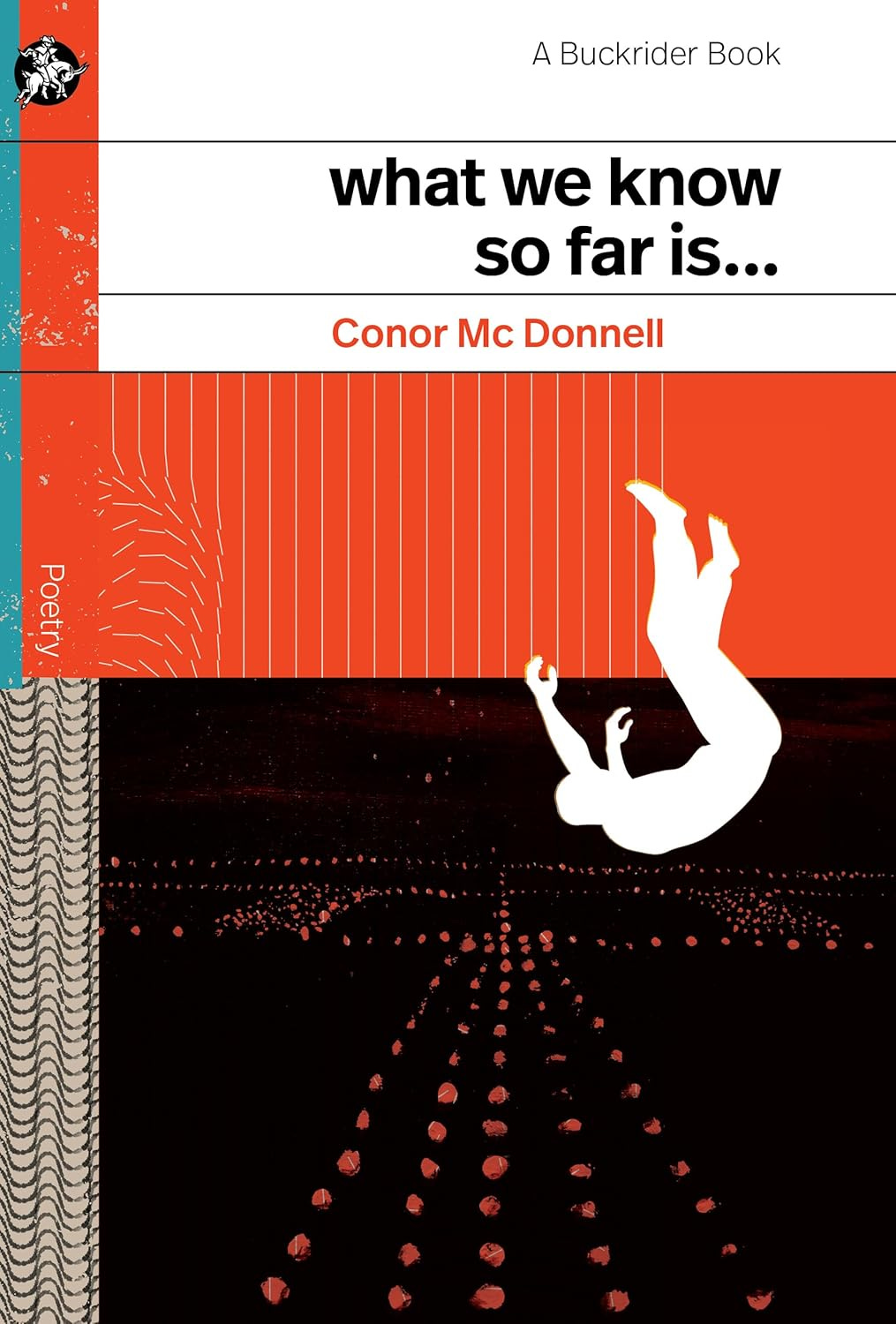
A few years back I was in the emergency room for some moderately painful infection, staring at the walls where they’d chosen to display their new Strategic Plan pillars in gigantic font, beginning with “1. STRENGTH through ENDURANCE.” Dr Conor Mc Donnell, a physician at the Toronto Hospital for Sick Children and author of the book-length poem What We Know So Far Is …, would seem to be familiar with this Nietszchean approach to patient-centred care. In fact, it’s striking just how many things would seem to be familiar to Mc Donnell. What We Know So Far Is … brings the reader into contact with a blistering intelligence, an astonishing breadth of allusion and scope of subject matter.
“I can’t do better than to say that What We Know So Far Is … reveals the most haunted parts of our lives, the bits we hope to ignore until they blindside us, the current that’s running there in our veins.”
Writing in The Woodlot, Mc Donnell explains that “I knew I wanted to pour everything into a piece of art that hit the earth like a meteor,” and that there came a point in the drafting of the work where “I dove headlong into a sea of language, mutations, memes, wordplay, Irish vocabulary and historical disasters and thrashed about for a year and a half. ... I read Paradise Lost, The Odyssey, and, most importantly, Ciaràn Carson’s translations of Dante’s Inferno, and the old Irish epic song, The Tàin.” In addition to these literary influences, the book draws heavily on scientific vocabulary. At times, it’s not unlike reading the molecular biology articles in the back half of Nature, replete with terms like “nephrology” and “nucleaolar core” and “titin isoform.” It all goes into the hopper and comes out in an extended, ecstatic, improbable, at times barely comprehensible stream that’s chopped and numbered as if the imposition of external order could corral the inherently ungovernable experience of being a mind in a body that’s breakable and controlled by chemicals. “We cannot calibrate so instead we medicate,” Mc Donnell tells us in the prologue. The work is wildly ambitious, in the way that medical science holds ambitions at the edge of mortality, tossing its practitioners repeatedly into the zone of failure. Throughout the work, we confront the limitations of our tools, be they words or scalpels or pharmaceuticals.
Language is an explicit theme throughout the book. “I believe words are thirsty predators: pack hunters: / to be seen is death to the herd, / to be heard means death-en-scene,” Mc Donnell suggests. “Words cower in the long grass of language ….” Early in the text he notes the informational coding aspect of DNA, comparing this to “omnibus Sandman, / Gandalf & Saruman, / Verses by Salman, / Sunset Dreams on vinyl, / cassette & double CD …,” imagining the non-coding sequences as an “escape” from such “accumulated rubbish ….”
Stylistically, Mc Donnell’s poem reaches for escape from some of the strictures of grammar and sentence, yet he’s also highly attuned to the more baroque patterns of phrasing, allowing alliterative and palindromic elements to dictate word choice. The play and freedom of the text complicate the seriousness of the subject matter, which after all is life and death. Perhaps, the poet suggests, “the biology machines will rid us of / this obsession with words for disease. / pray we can switch to magic, pull cures / from formulae of theories we knead”. Portions of the poem draw upon Mc Donnell’s work in hospital witnessing damage and loss, other parts of the text speak to internal experiences of mental and physical distress. “I thought a terrible thing to myself, then worried it to death: / which words steered me onto this ledge?” he asks.
Words can steer us into madness but can also bring us through. “This is why the first burial was the first act of love, / early words set ceremony as inchoate connection / to older ways when pupils pinned & dilated at will.” Still, language is a risky game: “If we do believe our ghosts leave / footprints and words are cruel sentinels, brutal // deceptions raise to feed off simple truths like / whistling down the underdog or calling across / the icefields or walking west to Mama Christ, // then maybe discrete paths will merge: / reveal the most haunted parts of us.”
I can’t do better than to say that What We Know So Far Is … reveals the most haunted parts of our lives, the bits we hope to ignore until they blindside us, the current that’s running there in our veins. The book reaches no conclusions, for we know only what we know, and so far that’s (always going to be) partial. It’s an astonishing, searing, mindbending piece of writing, a flight of words, and no easy landing.

About the Author
Dr. Conor Mc Donnell is a poet and physician at the Hospital for Sick Children, Toronto. He is the author of two collections of poems (most recently, This Insistent List) and three chapbooks. His poetry has appeared in various Canadian and international publications as well as noted medical journals such as JAMA and CMAJ. He is an associate professor at the University of Toronto and editor in chief of Case Repertory, a Narrative-Based Medicine Lab publication that seeks to engage and promote the voice of the patient in collaboration with their health-carers. He is a frequently invited international lecturer on pediatric perioperative care, error prevention and opioid stewardship, and he is current vice-president of the Canadian Pediatric Anesthesia Society. Conor works weekends at Sellers & Newel Second-Hand Books in Little Italy, Toronto, where they have words for people like him.
About the Reviewer
Dawn Macdonald lives in Whitehorse, Yukon, where she grew up without electricity or running water. She won the 2025 Canadian First Book Prize for her poetry collection Northerny. She posts weekly on Reviews of Books I Got for Free or Cheap (on Substack), as well as reviews for journals and The Seaboard Review of Books.
Book Details
Publisher : Buckrider Books
Publication date : Oct. 7 2025
Language : English
Print length : 96 pages
ISBN-10 : 1998408264
ISBN-13 : 978-1998408269
 | A guest post by
|
Wow! Mc Donnell’s collection may come to no conclusions but Dawn Macdonald’s headlong dive into it certainly brings her breathless and gasping readers to the same conclusions she has arrived at. “Astonishing, searing, mind bending.” I look forward to no easy landing.