

Women United by Peggy Nash and Julie White
Stories of Women’s Struggles for Equality in the Canadian Auto Workers Union

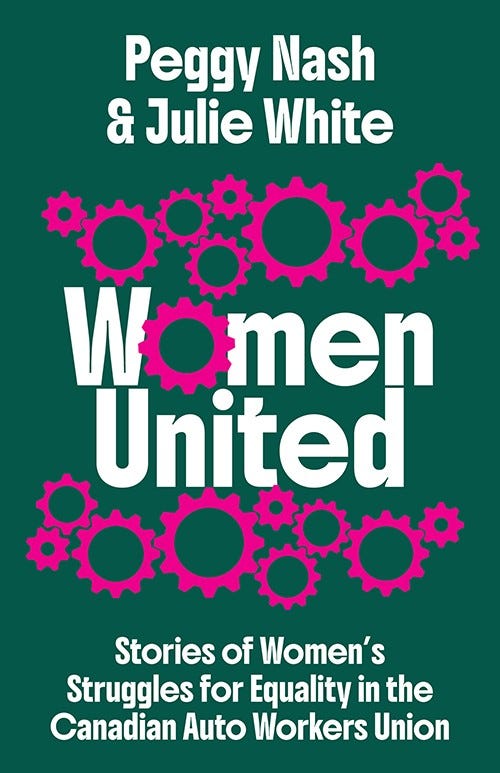
In Women United: Stories of Women’s Struggles for Equality in the Canadian Auto Workers Union, Peggy Nash and Julie White offer a history of women’s involvement in, and contributions to, the Canadian Auto Workers union (formerly United Auto Workers-Canada).
The book covers a time span from 1935 to 2014, which makes a logical end point. In 2013 the CAW joined with the CEP (Communications, Energy and Paperworkers Union of Canada) to form Unifor, marking a significant change in the union’s scope and structure.
As Nash and White point out in the preface, the book is not an initiative undertaken by the CAW, but by the authors themselves. As such, they were free to explore themes as they wished, rather than feeling pressure to portray a certain image.
The book is divided into sections covering different eras of the union. Within each section, chapters cover the contributions made by women, while also sketching out what was going on in the union more broadly at the time. With respect to the latter, for example, the authors discuss the CAW’s break with the UAW in 1985. Each chapter has a specific theme or focus, which adds interest to the narrative.
In Women United, the authors highlight the key issues female workers faced, both with their working conditions and within the union itself, at various points in history. The book also profiles women who made important contributions to the union.
Though the book focuses mainly on unionized workplaces in certain sectors, some of the struggles are universal, including dealing with workplace harassment and the battle for equal pay and equal opportunity. Both through the chronological narrative and the individual profiles, Nash and White give a sense of how child care and family responsibilities impacted women’s careers, and the sacrifices some had to make in order to progress within the organization. Women United also explores women’s contribution to unionization drives, like the one at Fleck Manufacturing.
Women United discusses the ways in which women in the union helped drive changes that benefited women and other marginalized workers, and highlights some of the men in union leadership positions, like Bob White, who supported women’s issues. There is extensive discussion of the union’s training initiatives to empower women and to improve the workplace environment. Nash and White also explore the connection between the union and the broader women’s movement.
Despite the success stories, there is also recognition that women faced obstacles in their efforts to rise within the union structure itself, with politics and the “old boys’ club” mentality creating barriers. Women also had to deal with harassment and resentment from co-workers, particularly when they started entering male-dominated workplaces.
Women United discusses the growth of the CAW beyond the auto industry, to include airline attendants, workers from the fisheries, rail car workers, and many others. It also explores the union’s efforts to counter violence against women. These efforts included broader advocacy supporting gun control.
One of the book’s strengths was the periodic inclusion of first-person comments from some of the women mentioned or profiled in the book. These paragraphs of own-viewpoint commentary enriched the text, and highlight the value of putting together a book of this nature to preserve the history while those involved were still around to give their input.
Nash and White themselves are well-suited to write a book of this nature, as both served with the CAW for a long period of time, holding various leadership positions as they worked on key initiatives. The authors note in the preface that part of their motivation in writing the book was to highlight the often-overlooked contributions made by women within the union.
Readers interested in historical perspectives on the contributions made by women to the CAW, in the history of the Canadian Auto Workers’ Union, in union activity in Canada, or in women’s history should find much of interest in Women United.

About the Authors
Peggy Nash is the executive director of the Canadian Centre for Policy Alternatives. She was the former senior negotiator in the Canadian Auto Workers (CAW), where she had the privilege of working with many groundbreaking union women from the 1980s to 2011. She led the CAW’s Women’s Department for many years and initiated innovative leadership programs. She was the first labour woman to lead national auto bargaining. Nash later became an NDP Member of Parliament, a lecturer in politics at Toronto Metropolitan University, and an author. Nash was named to the Order of Canada for her work in the union and was awarded an honorary Doctorate of Laws from Brock University. She lives in Toronto, Ontario.
Julie White is the former long-time Director of the CAW-Unifor Women’s Department. She held many leadership positions in her local union including becoming the first female president of CAW Local 27. She was elected to the union’s National Executive Board and was later appointed Director of the CAW Women’s Department. In this role, White was responsible for the union’s equity campaigns, education, mobilization, and workplace advocacy. She advocated for reproductive rights, childcare, the need for gun control legislation, and other measures to end gender-based violence. She lives in London, Ontario.
About the Reviewer
Ontario resident Lisa Timpf writes poetry, book reviews, short stories, and creative nonfiction. Her speculative poetry collections Cats and Dogs in Space (2025) and In Days to Come (2022) are available from Hiraeth Publishing in print and electronic formats. You can find out more about Lisa’s writing projects at http://lisatimpf.blogspot.com/. Lisa is also on Bluesky, @lisatimpf.bsky.social, and her author Facebook page is @lisa.timpf.author.
Book Details
Publisher: Between the Lines
Publication date: Nov. 4 2025
Language: English
Print length: 326 pages
ISBN-10: 1771136839
ISBN-13: 978-1771136839