

Wonderland Road by Carrianne Leung
Reviewed by Ian Colford

For decades, if not centuries, novels and other works depicting a post-apocalyptic world have formed a popular sub-genre of science fiction. Many of these works focus on the collapse of civilization and posit how such a calamity could come about. In the 21st-century we’ve seen a stream of works emerge that skip the actual mechanism of collapse and—inspired predominantly by the dire effects of environmental degradation and climate change—instead portray the aftermath as small groups of survivors struggle to cope with drastically altered circumstances.
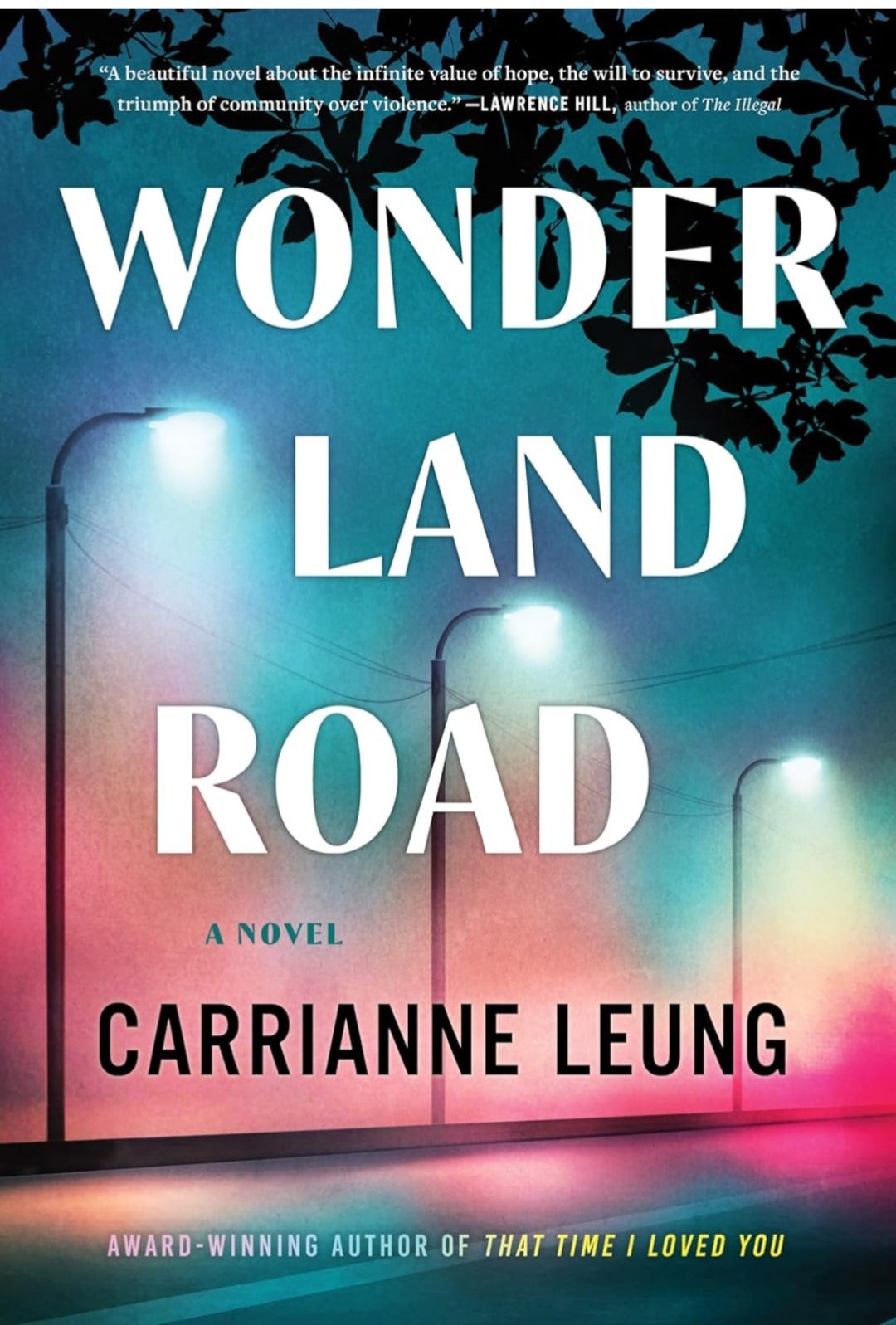
Carrianne Leung’s second novel, Wonderland Road, is set among a community of individuals living on Wonderland Road, a quasi-suburban enclave not far from an unnamed city crippled by unspecified events that a few years earlier led to the failure of civil society. Pauline has lived in the city for decades, having left her Wonderland Road home at a young age to escape her mother’s drinking and abusive behaviour. At one time she had a lover, who left her, and since then has been living almost as a hermit. One day, out of the blue, after no contact for almost 30 years, she receives a letter from her sister Mei. Their mother has died, and Mei is pleading with Pauline to return home to take care of her daughter, Jing.
“The triumph of Wonderland Road is Leung’s engaging cast of characters, many of whom come to matter greatly to the reader.”
In the absence of a governing body, a shadowy corporation called Bayson has moved in and filled a crucial gap, supplying people with food produced by farms located somewhere in the countryside, far from the city. In exchange for periodic (but increasingly unreliable) food deliveries from Bayson, the Wonderland Road group, along with other communities, provide Bayson with workers from among their members. Mei has agreed to leave home to work on one of the Bayson Farms. But with no one to care for her daughter, 12-year-old Jing will end up in the Children’s House with the other parentless children. Pauline is ambivalent, but with conditions in the city deteriorating and growing dangerous, she returns to Wonderland Road and assumes caregiving duties for her niece.
Leung’s narrative comes to us via three central characters: Pauline, Jing, and a teenage boy named Julian. Initially, Pauline is reserved and distrustful, finding herself among the unfamiliar remnants of her unhappy childhood. But as the seasons pass, we witness a gradual awakening of a more resilient and accepting self, until by the novel’s end she’s grown into something of a community leader. Julian’s tale is one of self-discovery as he struggles to come to terms with being gay. And Jing is an unusual child who misses her mother, sees ghosts, and whose best (and apparently only) friend is a crow named Iris. Looming over the action is the devastation that has wrecked the outside world, and which compels the community to pursue self-sufficiency while treating every stranger, every turn of the weather, as a possible threat to their survival.
The triumph of Wonderland Road is Leung’s engaging cast of characters, many of whom come to matter greatly to the reader. The quandaries they face, their recognition of each other’s needs and vulnerabilities, their willingness to sacrifice personal goals for the good of the community, their admissions of weakness and confusion … all of these leave lives and hearts exposed and bring the novel’s humanity to the surface.
Realistic but hopeful, Wonderland Road depicts—in terms vivid and humane—a world where much has gone wrong and the future is uncertain. But it is also a world where people continue to trust and love one another.

About the Author
CARRIANNE LEUNG is a fiction writer and educator. Her book of linked stories, That Time I Loved You, won the Danuta Gleed Literary Award for best first collection, was a finalist for the Toronto Book Award, and has been optioned for television. Her novel, The Wondrous Woo, was a finalist for the Toronto Book Award. She holds a PhD in sociology and equity studies from OISE/University of Toronto and teaches at the University of Guelph. She lives in Toronto.
About the Reviewer
Ian Colford has published three novels and two collections of stories. Evidence was published in 2008 by Porcupine’s Quill and won the Margaret and John Savage First Book Award; Evidence was also shortlisted for the Danuta Gleed Literary Award, the Thomas Head Raddall Atlantic Fiction Award and the ReLit Award. The Crimes of Hector Tomás followed in 2012. Published by Freehand Books of Calgary, it won Trade Book of the Year at the 2013 Alberta Book Publishing Awards. Perfect World was published by Freehand in 2016 and shortlisted in the book design category at the 2017 Alberta Book Publishing Awards. In 2019, A Dark House was published by Nimbus Publishing of Halifax and was shortlisted for the Alistair MacLeod Prize in Short Fiction at the Atlantic Book Awards and the Relit Award. In 2022 The Confessions of Joseph Blanchard won the Guernica Prize and was published by Guernica Editions in November 2023. Witness, a sequel to Evidence, will be published in 2026 by Galleon Books of Moncton, NB. He lives in Halifax, Nova Scotia. More info can be found at www.iancolford.com.
Book Details
Publisher : HarperCollins Publishers
Publication date : April 14 2026
Language : English
Print length : 304 pages
ISBN-10 : 1443464392
ISBN-13 : 978-1443464390