

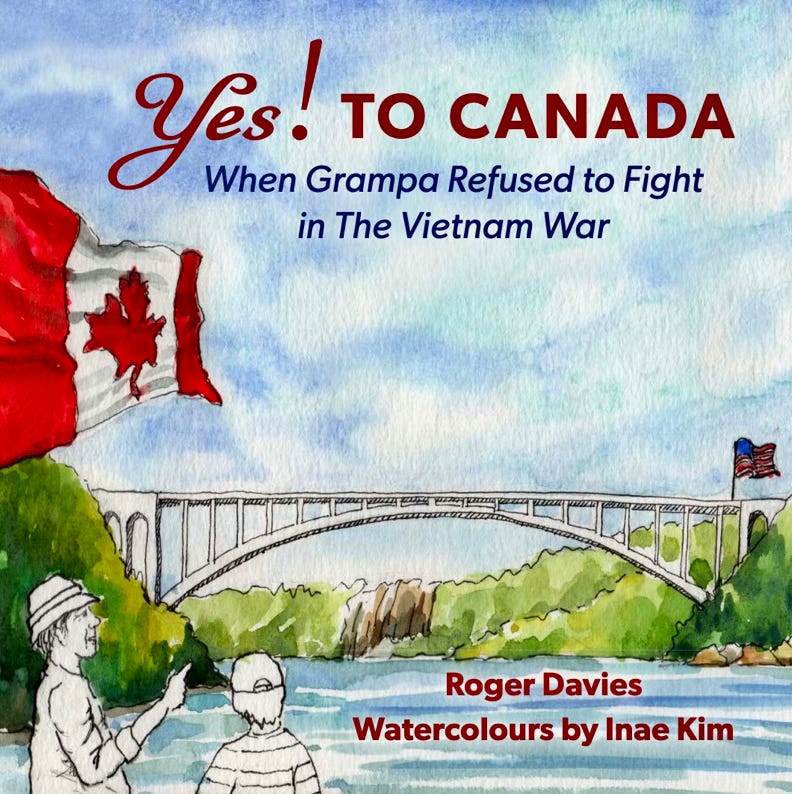
Yes! To Canada: When Grampa Refused to Fight in The Vietnam War
By Roger Davies, watercolours by Inae Kim, this poignant, powerful book for ages 10 and up illuminates both the courage and the self-doubts of U.S. draft dodgers who fled to Canada

There he is, U.S. Secretary of Defence Robert McNamara, smiling out from a page of Yes! To Canada: When Grampa Refused to Fight in the Vietnam War, by Roger Davies, watercolours by Inae Kim.
With his pleasant but non-flashy smile, oil-slicked hair parted in the middle, and expensive-cut, conservative suit, the former president of Ford Motor Company looks every inch Mr. Establishment. The photo, from the late 1960s, says it all: in that groovy era, you couldn’t get more un than McNamara.
Yet, as Yes! To Canada relates, in a 1967 memo to President Lyndon Johnson, McNamara dramatically broke loose from establishment thinking. Of American involvement in Vietnam, which he’d been an architect of, the secretary put it bluntly: “The picture of the world’s greatest superpower killing or seriously injuring 1,000 noncombatants a week, while trying to pound a tiny backward nation into submission on an issue whose merits are hotly disputed is not a pretty one.”
Wow. Or maybe not so wow. Anti-war activism wasn’t confined to long-haired students waving protest signs and screaming, “Hey, hey, LBJ, how many kids didja kill today?” Many objectors were serious, thoughtful types like McNamara—and, for young men facing the draft, tormented about whether to stay in the U.S.
For ages 10 to adult, Yes! To Canada, the story of several draft dodgers who fled to Canada, is both poignant and powerful. Here’s the Grampa of the title, explaining to grandson Toby about being a draft dodger:
“‘Fifty years ago right here and places like it, thousands of young men and women crossed the United States border into Canada to start a new life.’
“Grampa slowly added … ‘Without war.’”
It wasn’t easy to make the decision, Grampa recalls. Self-doubts abounded. “Hadn’t we driven the Nazi army out of France? How could it be that it is so wrong to make us fight in Vietnam? But it is!”
Another dodger, Tony McPhail, relates how, on arriving in Canada, he stayed with a Quaker family in London, Ontario. Nice as the family was, Tony often felt scared and homesick. In retrospect, Tony, now a farmer, says, “None of us is perfect, none of us knows how the future will unfold, but we can align ourselves with the forces of light and life in the world. It is worth the effort.”
Definitely worth it. In one of Yes! Canada’s vivid illustrations, U.S. bombers are destroying a Vietnamese village. The planes are ominous silhouettes against a sky orange with flames. At the bottom, fleeing, crying children are drawn in minimalist strokes—the contrast showing their vulnerability to the bombers pouring fire on them.
Inevitably, some Canadians disapproved of the newly arrived dodgers. I’m reminded of the sour old codger in the Beatles’ 1964 movie A Hard Day’s Night. “I fought the war for your sort!” he scolds Ringo. To which Ringo cheekily replies, “I bet you’re sorry you won.”
Fortunately, hospitable Canadians outnumbered and out-influenced codgers. Yes! To Canada quotes Prime Minister Pierre Trudeau, from 1971: “Those who make the conscientious judgement that they must not participate in this war… have my complete sympathy, and indeed our political approach has been to give them access to Canada.”
In the same mood, a vibrant watercolour depicts the Canadian flag, the red of the maple leaf as bright as hope, while a smiling immigration officer shakes hands with a newly arrived American. The welcomes worked: when U.S. President Jimmy Carter later granted the dodgers clemency, they were, of course, relieved—but at least half chose to stay in Canada.

About the Author
Roger Davies received a U.S. army draft notice in 1968. Accepted as a Landed Immigrant in Canada, he attended teacher’s college in Toronto. Roger’s career has included teaching in public schools, in an alternative school for at-risk youth, and in a prison. A father and grandfather, he co-authored a successful violence prevention course for youth and was a founding member of Men For Change, a Halifax group working to end violence against women.
About the Illustrator
Born in South Korea, Inae Kim earned a Bachelor of Fine Arts and Fine Art Teaching Certificate from Seowon University. After working in advertising and arts education, Inae immigrated to Canada in 1996. An elected member of the Canadian Society of Painters in Water Colour and the Contemporary Art Society, she has won both national and international awards. The Nova Scotia Art Bank houses a permanent collection of Inae’s art. Inae lives in Halifax with her family.
About the Reviewer
Melanie Jackson is a Vancouver freelance writer/editor. She’s also the award-winning author of middle-grade/YA suspensers, including Orca Books’ Dinah Galloway Mystery Series, and several chillers set in amusement parks. Visit Melanie’s page at The Writers’ Union of Canada.
Book Details
Publisher: HARP Publishing, January 2026
Language: English
ISBN: 9781990137747
Paperback: 66 pages.