
Yield: a poem by Jaime Forsythe
Reviewed by Dawn Macdonald

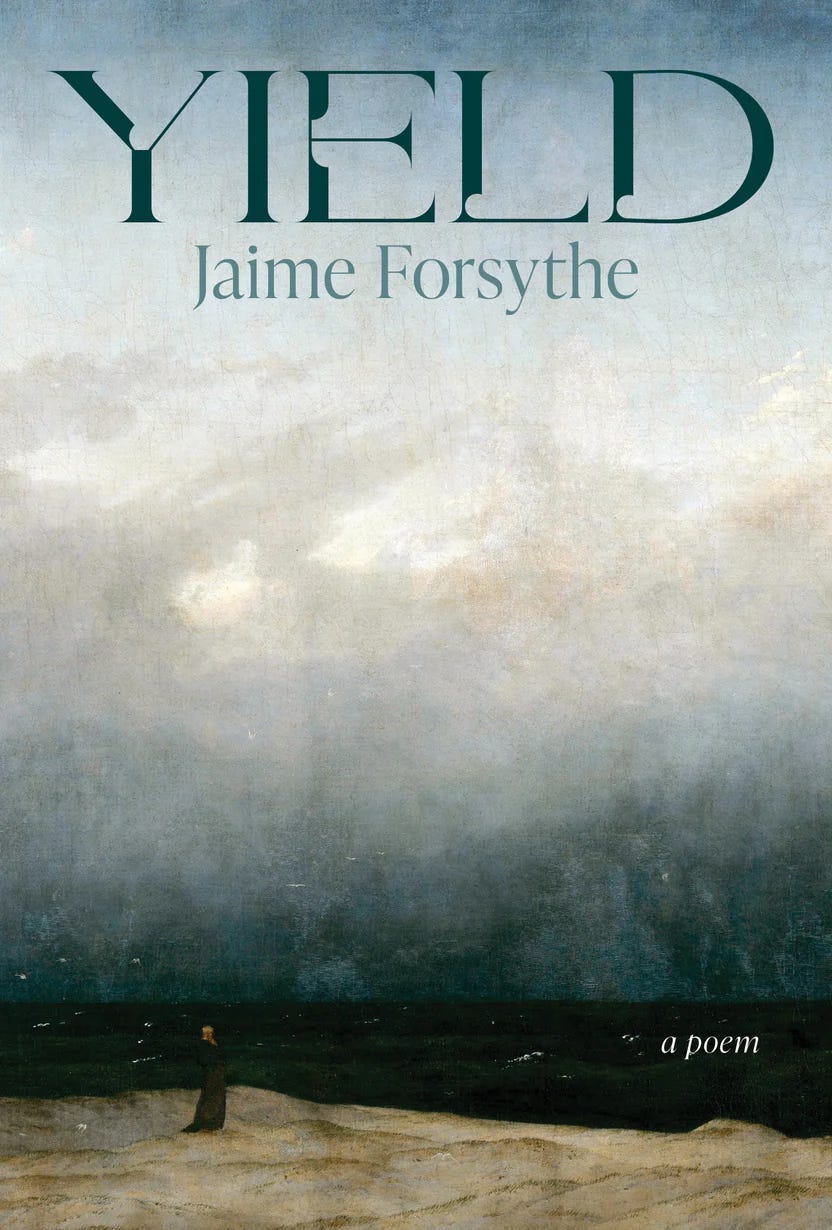
I know you think that taking your newborn to a cottage at the seaside is a good idea, but it really isn’t. All that seastuff is very squashy and gross and maternal-body-organic, and anyway the isolation is really gonna get ya, postpartum-wise. It might, however, be good for your poetry.
Jaime Forsythe’s Yield is a book-length poem set in unrhymed couplets with line lengths that are consistent within sub-divisions of the piece, though varying between these parts. She’s bringing a high level of intellectual precision to her exploration of natural processes outside of immediate control (birthing, ecosystem functioning and decay). As she puts it toward the end of the piece, “The outside / wants in and I lack the authority to intervene, // what I try to give is attention.”
Or, jumping back just a few stanzas, “Vitamin under my tongue, // spooning tinned peaches, I see a perfect cloud / afloat in the breakfast nook of a house we don’t // own: the cloud isn’t mine to explain, eradicate / or control.” I want to unpack a couple of things from those lines—the house they don’t own underscoring the provisional tenancy of a person in a landscape; the bundling here of explanation with eradication and control—that the attention we give to our surroundings should be, let’s say, the open attentional field of meditation rather than the inductive reasoning that discovers law and pattern. And yet this poem is carefully patterned, and seeks, if not explanation, some understanding; perhaps an understanding ultimately of the self within the environment rather than of the workings of that environment as it could be viewed by the disinterested observer. We become, then, the baby as-yet undifferentiated in its selfhood: “The baby unusually content, / absorbing a confusion he’ll forget, eating his feet.”
Forsythe brings her focus to boundaries and the blurring thereof: land and ocean, child and womb, body and environment, and the pressure on planetary boundaries exerted by human activity in the Anthropocene. I’d like to quote one section at length, with the note that the “elevator” in these lines is a reference to the instructions for doing Kegels (lift the elevator, then let it back down slowly etc.):
Local cephalopods don’t notice
us sharpening our knives, busy

as they are with their three hearts.
Toxins swim past visions of a harsh

and tentacled light. Medicine softens
my gaze but also leaks past the blood-

brain barrier, gets flushed into the ocean, causes crabs to engage in risky behaviour

and relate differently to their own species.
Gripping the bank, an elevator offers

a way out, the machinery of its muscles
slick on silent motor’s heartbeat,

buried under veined roots. Nothing to do but ascend two stories, effortless upon

emptying myself of all I once had, combed
my glitching interior for an idea with teeth.
I’m always interested in seeing how a poet chooses to approach the abyss—does she throw herself over, or very deliberately operate the elevator? Forsythe has the admirable presence of mind to maintain a firm hand on the mechanism even while plainly telling us that control is not possible in the circumstances. Even the book’s title, Yield, would sound at first like an exhortation to let go, but if we think about what it means to yield in traffic it isn’t an undisciplined move; it’s just a pause before proceeding within an orderly flow. I’m not sure I agree with this stance (I mean I do in traffic of course), but I can respect the focus that is involved in Forsythe’s methods, and the sheer intelligence she’s bringing to bear.
About the Author
Jaime Forsythe’s previous books are I Heard Something (Anvil Press, 2018) and Sympathy Loophole (Mansfield Press, 2012). Her poetry and fiction have appeared in Arc, EVENT, Grain, The Malahat Review, Geist, The Ampersand Review, and This Magazine, among others. She holds an MFA in Creative Writing from the University of Guelph and currently lives close to where she grew up in Nova Scotia/ Mi’kma’ki.
About the Reviewer
Dawn Macdonald lives in Whitehorse, Yukon, where she grew up without electricity or running water. She won the 2025 Canadian First Book Prize for her poetry collection Northerny. She posts weekly on Reviews of Books I Got for Free or Cheap (on Substack), as well as reviews for journals and The Seaboard Review of Books.
Book Details
Publisher Buckrider Books
Publication date April 14 2026
Language English
Print length 72 pages
ISBN-10 1998408396
ISBN-13 978-1998408399