

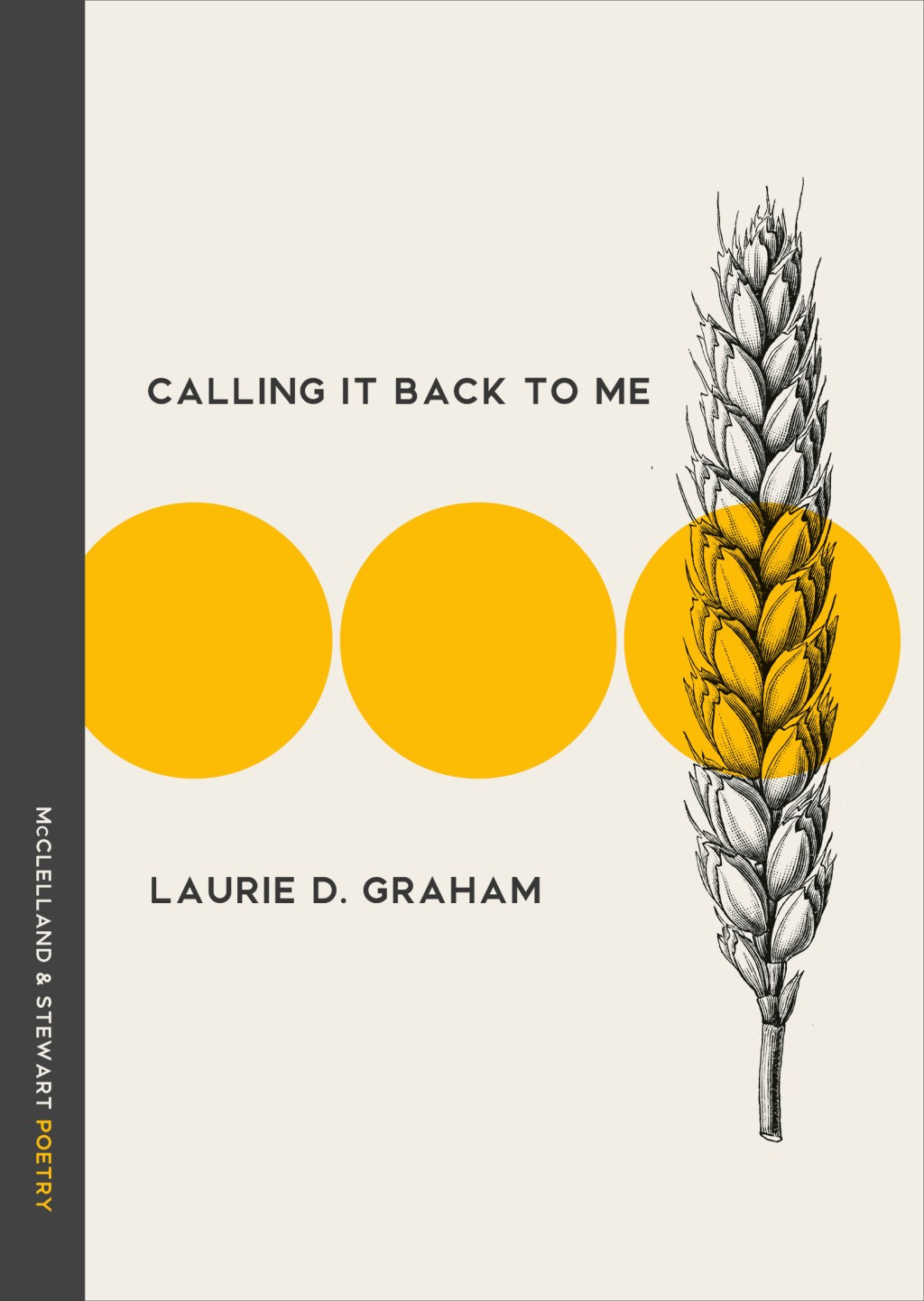
Calling It Back to Me by Laurie D. Graham
Reviewed by Bryn Robinson

Where does family — those long threads of lineage that tie us to something more than our individual selves — reside?
We often consider memory to be a deeply personal — and solo — process of storing and retrieving information. After finishing Laurie Graham’s latest poetry collection, though, I realize how short-sighted (albeit scientifically accurate) that interpretation was. Rather, it is more accurate to our experience that memory is constructed in collaboration — in relationship with — others, and therefore the responsibility of storing and retrieving memories rests with the many who make up an individual’s circle.
Memory, after all, is
something you do together.
Mind you, that responsibility is not necessarily upheld well by and for every person. It’s a weighty task to assume the mantle of family storyteller, especially as one endeavours to do so through poetry — making music of the mountains of illegible scanned records, threads of stories passed between relatives, and boxes of visual reminders that your roots run long and deep through distant geographies and time. Those of you who have taken the plunge into deciphering your family’s roots will deeply appreciate Graham’s introspective lyrics as she undertakes to preserve memories of immigrant ancestors, and care for their descendants whose own ability to recall and remember begins to sputter. It’s a daunting task (“I knew then/I’d have to work/the rest of my life/to call it back…”).
Setting the table with an initial short visual poem that effectively disperses the words like seeds to the wind (much as I imagine new arrivals must have felt stepping onto nascent Canadian farmlands), the collection begins with the process of “calling it back”: taking stock of, and sorting through, the vast ephemera passed down through the various branches of the family tree. These memories now sit with an elderly loved one, to be sorted by the author before a move. This first piece spills its’ words like the chaos found while sorting through drawers and dark corners of rooms, as one does when “everything’s coming apart/she’s taking apart her room”. The cleaning of many lifetimes’ possessions, and the subsequent need to get everything down before memories are lost forever within one’s fading voice, is a daunting, yet sadly familiar, task to many of us. There’s an urgency that comes with work, and the form does well to match it.
There is another layer of introspection embedded in the pieces and which is a frequent companion of such emotional work: The recognition of the emergence of a new life phase that leads to a “mourning process” for the end of women’s voices in the family (“…my years/of fruitless bleeding/have been definitive”). In perhaps the second most poignant phrase of the collection - “I miss the lives/I have not lived” - Graham speaks to both the process of not knowing (yet) the women whose histories are speaking from the ancestral records, but also the not knowing the people she could have chosen to be in her own story. Not an uncommon thought that bubbles up at midlife, but she shares it deftly.
In endeavouring to better understand the lives - the possibilities - that lie deep in her cells, she examines each of her great-grandmothers in turn, “hooking my strings/between points on the globe/expecting answers”. Each of the poems paints portraits that give effect to their unique journeys and personalities, altering pacing and presentation to create unique personalities (one piece was especially tight and formal, another more visual patchwork to perhaps mimic typically spotty ancestral records). She remarks that, frequently, these women have been relegated to secondary characters - “The hidden names removed/ by marriage…”, and new roles and duties imposed on them. What lives had they not lived? This is an infinitely introspective exercise, especially when one considers how family tales passed down only share “the tenor of reasons, not the reasons themselves” because the past can be difficult to discuss (“what’s said is brief by design”). The possible lives are truly endless.
The collection ends with Graham finding “a good closing” with their elderly loved one, whose own memory is no longer reliable (but “how it’s like her mother but not like her mother at all”) and which further complicates the collaboration in memory making (“…even with repeated visits because the world is changing constantly in and around us”). Here, we find my favourite line of the book, as she considers things that she misses yet running through her in deeper channels:
          I miss the
vernaculars that died
with me, the languages
dead and struggling inside
of me.
Calling It Back to Me speaks both to the fragility of the individual story and the enduring, unconscious pulse that thrums underneath it all to tie a family together. For those up to the task of understanding their own place within the infinite fabric of space and time, reading Graham’s own experiences with these questions would be a beautifully challenging place to start.
Then ask yourself: What lives have you not lived?

About the Author
Laurie D. Graham grew up in Treaty 6 Territory, near amiskwaciwâskahikan (Edmonton, Alberta), and she has lived in Nogojiwanong/Peterborough, in the Territory of the Mississauga Anishinaabeg, since 2018, where she is a poet, an editor, and the publisher of Brick magazine, a journal of literary non-fiction based in Toronto. Her first book, Rove, was shortlisted for the Gerald Lampert Memorial Award for the best first book of poetry in Canada. Her second and third books, Settler Education and Fast Commute, were both nominated for Ontario’s Trillium Book Award for Poetry.
About the Reviewer
Bryn Robinson (she/her) lives in New Brunswick, Canada, where she uses her PhD in experimental psychology to support mental health programming in the province. She prefers contemporary fiction, narrative non-fiction, graphic novels and poetry that is emotional, reflective, and if it can do it with humour, all the better. Bryn also writes on Campfire Notebook, where she regularly features her original poetry, photography, and other art. When not reading, she’s searching for birds in the New Brunswick forests and seascapes, camera in hand.
Book Details
Publisher : McClelland & Stewart (March 24, 2026)
Contact & Ordering Information:
Language : English
Paperback : 79 pages
ISBN : 9780771023460
"I miss the
vernaculars that died
with me, the languages
dead and struggling inside
of me."