


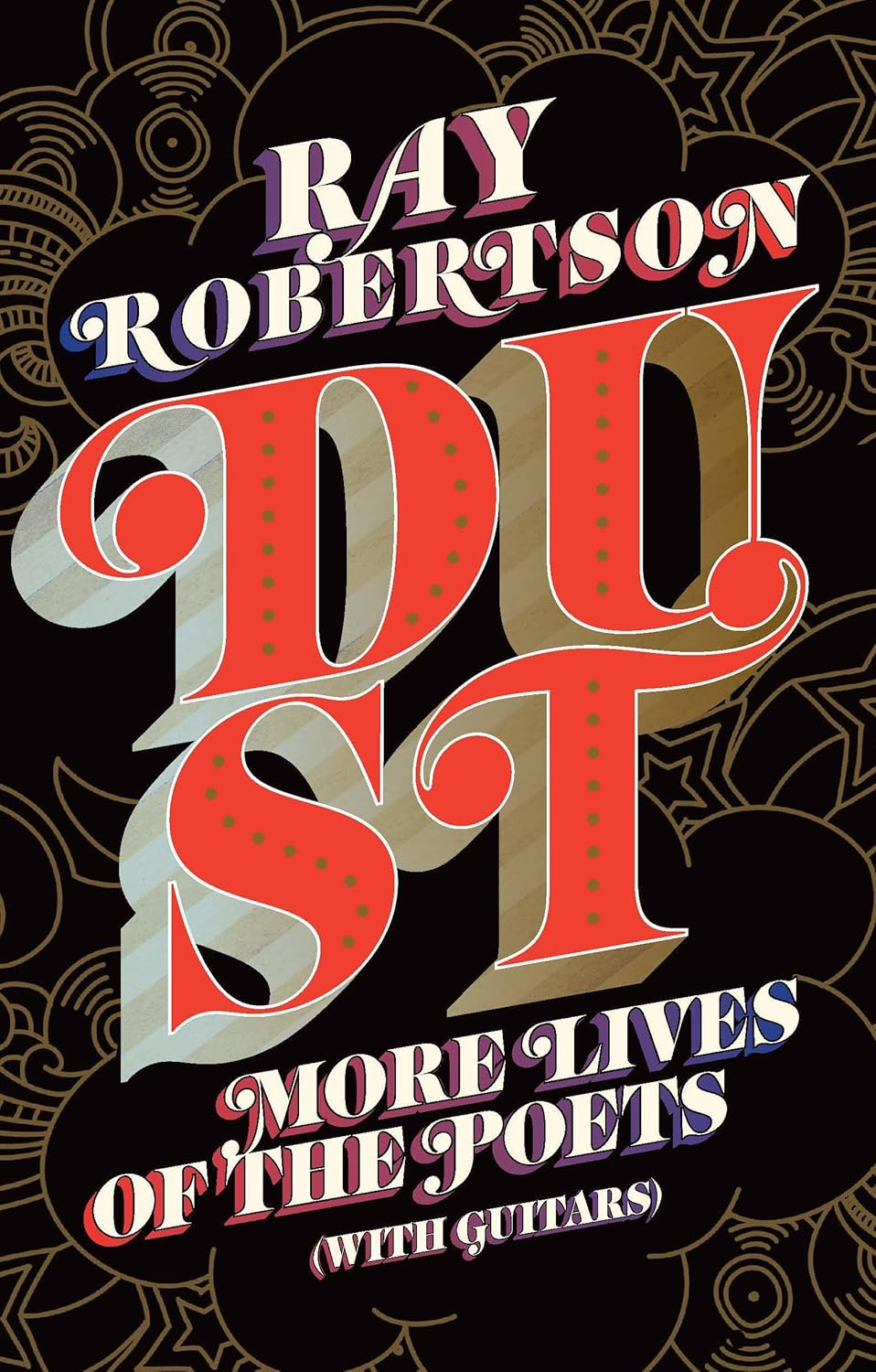
I first encountered Ray Robertson’s talent for assessment in Mental Arithmetic, a 2004 collection of book reviews and essays originating in The Globe and Mail and Toronto Star. He came across as a sharp, witty and provocative critic, and I kept his name in mind as the years rolled by, years in which much prose, fiction and otherwise, appeared and his personal troubles with depression were made known.
Dust is something of a sequel to Lives Of The Poets (2016), and sad to report, is slated to be the last gasp and not part two of the trilogy I was hoping for. As the artists covered and eras evoked were ones I swam delightedly through myself, many names popped into my mind as potential for further admiration and dissection. From the obvious, Joni Mitchell, Paul Simon, Randy Newman, Van Dyke Parks, to the cult faves like John Martyn, Leo Kottke, Ry Cooder, Michael Chapman, Terry Riley, Laurie Andersen, Leslie Feist, Robyn Hitchcock, Bruce Cockburn.
Between the two Lives of the Poets came his love fest with the Grateful Dead, All The Years Combine: The Grateful Dead In Fifty Shows (2023), which takes some ploughing through as twenty versions of the same pieces are shuffled and compared. It’s a brave effort, aimed at lifelong fans who just can’t get enough and yes, it compares favourably with others in the genre, like Eric F. Wybenga’s Dead To The Core (1997). Of course, the holy grail is to subject yourself to Live/Dead or Europe 72, with suitable herbal enhancement and maybe a couple or thee single malts, perched inside surround sound speakers: the space where analysis exhausts itself and aural splendour takes over.
To be fair, much the same can be said of the glory years of jazz, for me, the 1955-65 period or the early 20th century, where Ravel, Debussy, Stravinsky, and Schoenberg set the template for the orchestral 20th century. Groups of musicians and composers seem to arrive as a package assembled elsewhere for the jump-starting of traditions on the edge of ossifying. The Rite of Spring, Sgt. Pepper, Kind Of Blue, Are You Experienced, Bookends, Pet Sounds, Time Out, they all sparked new growth in their genres. Okay, throw in Blonde on Blonde; it is far tougher to exclude than include.
In both Lives of the Poets, Robertson reveals a distinct tendency to side with the self-destructive, addicted loser, whose supposed genius is repeatedly marred by poor career choices and the crutch of booze, drugs, and promiscuity. It’s a jagged path for bruised survivors, and some, like Gene Clark (rocker) and Townes Van Zant (folkie), failed the inner fortitude test, for a variety of reasons that could be classed, if one were so inclined, as wimpiness. That long-lifers like James Taylor and Eric Clapton faced the same challenges but kept their hands on the wheel of their careers seems to be only another reason to snarkily dispose of their cultural contribution in carefully doled out snorts of derision. If your audience is tiny but devoted rather than large and loud, then you are automatically on Robertson’s team. Hey man, pull up a chair and have a brew, even if you’re a virtual corpse.
“Every music critic assumes it’s his duty to let the reader know exactly where his disapproval lurks, and Robertson lines up with his fellow scowlers Nick Kent and Lester Bangs.”
In his selection of eccentrics and occasional innovators, Captain Beefheart, Gram Parsons, and Alan Wilson, he opts for praise grounded in pity and the assumption that achievement over the long haul is somehow only a lucky draw in the carnival of capitalist corruption. No doubt aided by mob money and sleazy managers. That it might be the product of hard work and dedication seems immediately suspect. Dying young beside an empty bottle or dirty syringe automatically guarantees gilded immortality in Robertson’s book, but continuing to thrill thousands into your eighties, as Mick Jagger, Ian Anderson, Joan Baez or Judy Collins dumps you into his slop bucket to be ignored until it curdles.
Every music critic assumes it’s his duty to let the reader know exactly where his disapproval lurks, and Robertson lines up with his fellow scowlers Nick Kent and Lester Bangs.
Spending time eulogizing the likes of Nico or The Ramones seems a waste of space to these ears. Pages on Willie Bennett and Handsome Ned and nothing on Bruce Cockburn, really? Give me a break, dude. With Dust, he partially redeems himself with insightful chapters on The Staple Singers, Muddy Waters and Nick Drake, talents worth dissecting. But perhaps I am carping over his choices and neglecting his knowledge and insight?
For sure, his examination of his areas of interest is exemplary. This man knows. All the bios, all the scuttlebutt, all the obscure interviews. More on Townes Van Zant and Captain Beefheart than you will ever want to hear. Ditto Duster Bennett and Alex Chilton. Another example, that late arrival to the early Fleetwood Mac, Danny Kirwan, is covered with delicacy and insight, even though the man only composed about maybe 5 or 6 elegant instrumentals in the shadow of the band’s progenitor and resident genius, Peter Green. Perhaps spending his last thirty years alcoholic, unemployable and often homeless rather than his brief tenure entertaining audiences, gains him automatic admission.
Whether it is to impress his uneducated audience or elevate his ignominious carping, Robertson has a habit of inserting literary quotes and bon mots from the canon, from Samuel Johnson, John Dryden, Alexander Pope, Joseph Addison, John Milton, William Congreve, to Heraclitus and other notables from the distant past. Milton and Chilton make strange bedfellows, but perhaps no more than Pink Anderson and Floyd Council do with Pink Floyd. While I was charmed by this peccadillo, I suspect many will sail on by, busily checking out his fulsome praise and cheeky put-downs to see if it matches their own. And despite his college grad allusions and the high culture they imply, his love seems to always resolve into blues and country and the folkies and rockers who shamelessly mined those wells for sustenance and inspiration. That others might gravitate to jazz, classical and what we now term world music seems beyond his carefully gardened ken.
If he did, that might lead to his obvious bête noire, prog. Like many North American critics, he cannot abide the subtle complexities of progressive rock and folk (unless it’s the Dead deep in the space frolic of Dark Star), preferring that fraudulent mantra ‘three chords and the truth’. Heck, he might risk an upbraiding at his local watering hole, and we can’t have that, can we?

About the Author
Ray Robertson is the author of nine novels, six collections of non-fiction, and a book of poetry. His work has been translated into several languages. He contributed liner notes to three Grateful Dead archival releases: Dave’s Picks #45, the Here Comes Sunshine 1973 boxed set, and the From the Mars Hotel 50th Anniversary Deluxe Edition. Born and raised in Chatham, Ontario, he lives in Toronto.
About the Reviewer
Gordon Phinn, a longtime resident of Oakville, Ontario, has been active in literary production since 1975, with several titles in a variety of genres to his credit: Non-fiction, fiction, poetry, criticism and memoir. His early critical work for Books In Canada and Paragraph is collected in It’s All About Me, and his four-year reviewing stint at WordCity will soon be available as Joy In All Genres. Other recent essay collections: Bowering and McFadden, Laughing At The Universe Of Lies and Consciousness: A Primer. A novel, An American In Heaven, a memoir Moving Through Many Dimensions and a poetry collection, Winter, Spring and Eternity’s Seduction. He is currently editing a collection of essays in celebration of the work of Laurence Hutchman, to be published by Guernica in 2026.
Book Details
Publisher : Biblioasis
Publication date : Nov. 11 2025
Language : English
Print length : 288 pages
ISBN-10 : 1771966556
ISBN-13 : 978-1771966559
