

Encampment: Resistance, Grace, and an Unhoused Community by Maggie Helwig
Reviewed by Christina Barber


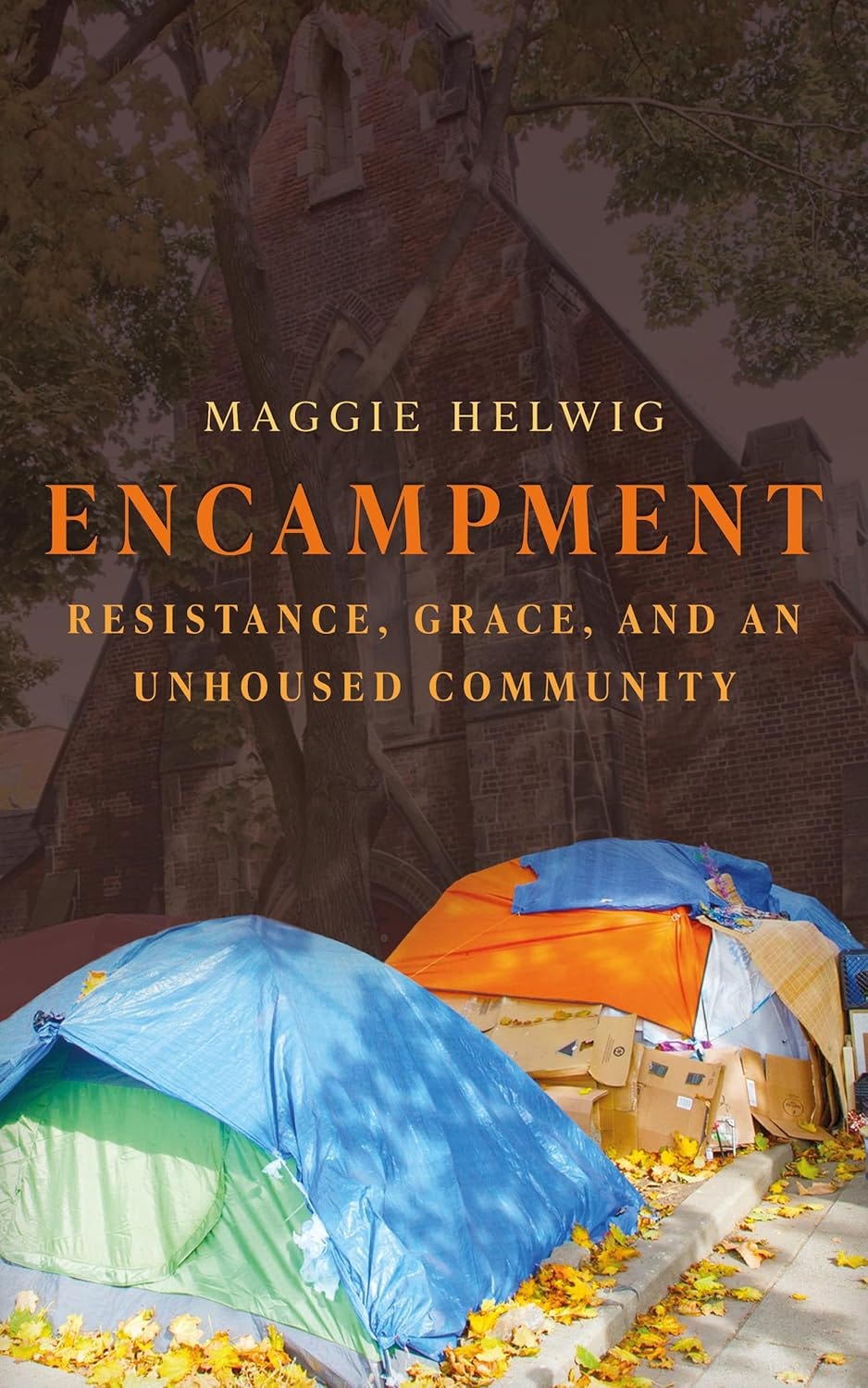
Across Canada, people are facing unprecedented challenges that arise from poverty and addiction. A steadily growing number of cities are crying out for an end to homeless encampments, declaring states of emergency, an end to the occupation of city property, and for a dispersal of vulnerable peoples. The marginalized and disenfranchised inhabit city property lacking support, options, or many of the rights and benefits that housed people take for granted. Entire parks and streets have, at various points, become ad-hoc communities of people doing the best they can to get by in entirely undesirable and unforgiving circumstances. Pleas for short-term emergency care and long-term solutions either fall on deaf ears or fall prey to the glacial pace that afflicts all levels of government. Thus, it may be cruel irony or simply a testament to the grave necessity of her book. Maggie Helwig’s recent experiences punctuate the larger realities of the urban houseless and the often inhumane treatment enacted upon them by city officials. The book aims to “clean up” and “clear out” the ad-hoc housing situations created by these most vulnerable and marginalized peoples in our communities.
On October 15th of this year, Helwig, the Toronto-based Anglican Priest of St. Stephen’s-in-the Field, was awarded the $20 000 Toronto Book Award for her nonfiction book Encampment: Resistance, Grace, and an Unhoused Community, and the following day, the St. Stephen’s-in-the-Fields church encampment was cleared and replaced with concrete blocks.12

This was not the first time the church encampment had been cleared. As housing activist Helwig asserts, it is not simply the dislocation of inanimate objects from one site to another but human beings whose lives are regularly disrupted and upended, most often without appropriate, proportional, or long-term solutions:
“It is not incredible, it is even normal, that if you live on the street, anything you love may be taken away, for no reason, with no notice, and there will be nothing at all you can do, and if you try to explain, probably no one will think it could be true.” (p.130)
Helwig’s memoir centres around her experiences and actions during the COVID-19 pandemic and the years following, while serving as a priest in the heart of Toronto’s storied Kensington Market. An eclectic neighbourhood characterized by bakeries, grocers, vintage shops, and restaurants, Kensington has long reflected the vibrant nature of its multicultural makeup. A place immigrants could call home, and where a sense of community was key, has not weathered well the increasing needs of the unhoused. Here, too, gentrification has led to community members at odds with the church and the itinerant people who shelter there.
Helwig’s story is one of compassion, service, activism, and steady patience for the people she helps daily. Encampment is a primer for the realities of the unhoused in Canada’s largest city, as well as for the realities of the people who care for and support people in crisis. Her account is often heartbreaking, but tells too of the humility and humanity present in Helwig’s world. Vibrant, larger-than-life, and sometimes enigmatic figures populate her narrative, and she finds ways to show the humanity of the people who, but for a lack of stable housing, are still residents and members of this — or any community.
The displacement of encampments in Toronto extends beyond the yard at St. Stephen’s-in-the-Field and has impacted hundreds of residents. When announcements are made by city officials before the clearance of tent encampments, the message to the public maintains that services are available to the dispossessed, especially shelter space. Yet, as Helwig painstakingly relates, countless hours on hold to emergency housing support reveal that the real picture of the lives of unhoused peoples in Toronto is entirely different to that proposed by officials:
“And if none of them believe that truth that there are no shelters, that there is no housing, that there are no long-stay treatment facilities for anyone other than the wealthy, that is in part because they have been wilfully misinformed by others with more power. But it is also because they have been prepared to believe the misinformation, because the alternative would be to accept that someone they loved could also end up in this place. (p.118)
At a cost of millions of dollars in law enforcement and inhibitory structures including fences and concrete blocks, the ultimate reality of encampment eviction is, in large part, only expeditious displacement of people to smaller venues. They are less visible, but no less homeless and no less in need of services. The City of Toronto reflected on its actions in the 2021 clearing of the encampment at Trinity Bellwoods (Ombudsman Toronto Investigation Report, published March 4th, 2023):
“The City owes a particularly high duty of fairness to those living in encampments. Our investigation found that the City chose expediency over the needs of the individual: its focus on enforcement meant that it discounted the experiences of and impact on individuals in encampments. As a result, the City caused undue confusion and harm.
“The overall result was significant unfairness in how the City planned, engaged stakeholders, and communicated about the encampment clearings. The City showed a lack of commitment to honouring its pledge to a human rights approach and to serving this vulnerable population with the dignity and respect they deserve.” 3
One would hope that this report would encourage citizens to believe more humane and sustainable practices would be sought and implemented. Helwig’s account, however, shows a continued need for the city government to moderate and diversify its approach.
Encampment is a powerful testament to the crisis faced by Canada’s homeless populations in Toronto and beyond. Helwig outlines the dark realities of the systems which are purported to provide solutions to various urban crises, shining a light on their extensive inefficiencies. The endurance and fervour exhibited by Helwig and others in fighting to support not only local encampment residents but also others living in the margins is inspiring and often empowering. Helwig’s detailing of distinct criticisms targeted at municipal and provincial systems points out specific deficiencies to look for in cities across the country. This could provide citizens with the examples and means to call out local governments and to engage with local politicians on issues related to homelessness and addiction.
If there is money in the system to combat “the problem” through force, so then is there money available to treat “the problem” with care — provided we choose to take the higher road as citizens to demand that our government enact humane, supportive, and long-term solutions for people in need.
“The true, terrible threat is that, if you just once let those people get too close, you might learn that, underneath it all, we actually are the same. Poor, bare, forked animals in King Lear’s storm, in a world that is always ending.” (p.66)
ONE OF THE GLOBE AND MAIL’S BEST BOOKS OF 2025

About the Author
Maggie Helwig (she/they) is a white settler in Tkaronto/Toronto, and is the author of fifteen books and chapbooks, including Encampment: Resistance, Grace, and an Unhoused Community, which was awarded the 2025 Toronto Book Award, and Girls Fall Down (Coach House Books, 2008), which was shortlisted for the Toronto Book Award and chosen as the One Book Toronto in 2012. Helwig is a long-time social justice activist, and also an Anglican priest, and has been the rector of the Church of St. Stephen-inthe-Fields since 2012.
About the Reviewer
Christina Barber is a writer, dramaturge, artist, and educator based in Vancouver. Her poetry has appeared in The Whimsical Poet and contributed to the Vancouver City Poems Project.
Book Details
Publisher : Coach House Books
Publication date : May 13 2025
Language : English
Print length : 176 pages
ISBN-10 : 1552455041
ISBN-13 : 978-1552455043
 | A guest post by
|