


“Arousing from the most profound slumbers, we break the gossamer web of some dream. Yet in a second afterward, (so frail may that web have been) we remember not that we have dreamed.” —Edgar Allan Poe
Ever wake up from a dream and think, “I wish there was a way to record our dreams so that I could recall it in all its detail?” I've frequently wished for this because I just lack the words to adequately convey the dream's main idea, let alone all of its vivid details.
Fortunately, there is a writer here on the East Coast, Sheila Graham-Smith, who has written a very dream-like novel if, after snow, her second novel. Of her first book, The View from Errisbeg, reviewer Alison Manley highly praised it in these words:
“A beautifully written, quiet, engaging story, and one that immediately felt like a favourite sweater wrapping around me.”1
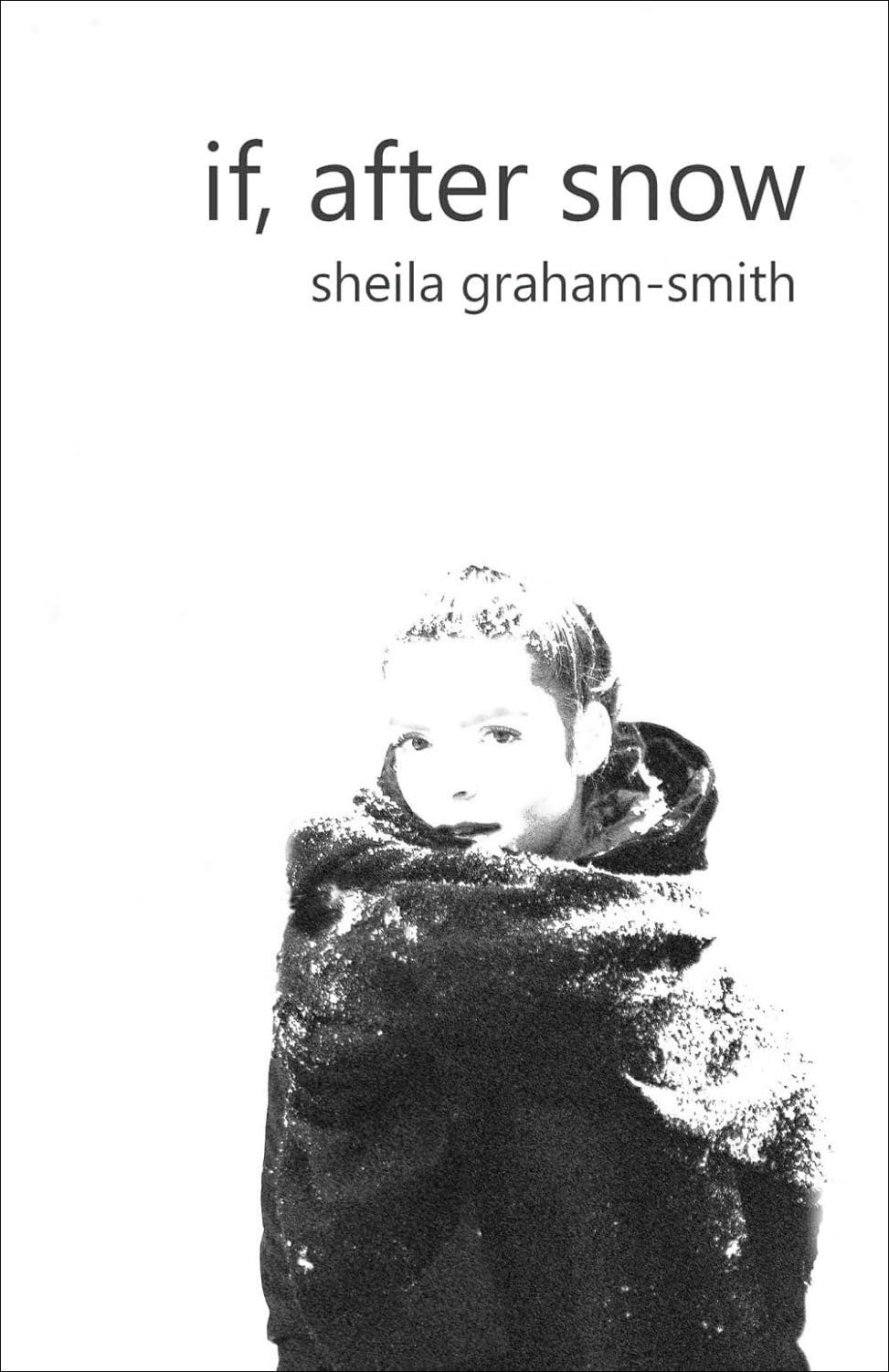
Snowfall can, under the right circumstances, give any vista an ethereal, dream-like quality, and snow is predominately featured in if, after snow. In fact, the book’s cover is very stark, in strict black and white, with a plain Arial lowercase font. The image on the cover is a pixie-like woman wrapped in a blanket with what looks like a dusting of snow on her. She is looking right at the camera and doesn’t appear to be cold in the least. Does this image represent Miriam, the female protagonist of the story? I like to think so, and the more I read, the more that this picture popped into my head.
He [Kit] hadn't taken his eyes off her since they came in, as if he recognised the absence of some not quite human element. She would have been conventionally pretty, in a grey-eyed, smooth-cheeked, nice bones sort of way, if it hadn't been for the startling white of her lashes, the snowy hair, the pale, pale skin. As it was, she was something so out of the ordinary it was difficult to take her in. He had apparently decided not looking at her at all was probably the safest thing.
Adding to the dream-like quality of if, after snow is the way the story unfolds, taking its time, and with glimpses of the gathering narrative as if through a gentle, silent snowfall. Characters and scenes drift in and out, never fully detailed or situated in the storyline, or set in flashbacks thirty years before when Carl, Miriam’s and Corby’s adopted father first “met”. For they came together, by happenstance, just after a snowstorm has passed through town. While Carl was loading groceries into his car, a young impoverished woman with a young girl and a baby asked Carl to watch them. She ran back into the store to get her keys.
She came into his life in the parking lot of the local Save-Easy on a winter afternoon, in the wake of a snowstorm.Heralded, as it were, by a dazzle of white.
He was putting groceries into the back of his car. From his left came the strident squeak of a metal wheel. He looked up. Then looked again. A young woman struggled through the snow with a shopping cart. She pushed. The cart resisted. The front wheel turned to one side, protested loudly, stuck. She pushed again. The wheel stuck again. She paused as she came up alongside him and rummaged through her purchases. There was a baby in the bottom of the cart, strapped into a carrying basket, almost lost amongst the packages.
“Excuse me.”
There were tears threatening. He could hear them. He wasn’t good at judging age, but she was young, all dark circles under the eyes and dark hair that hadn’t seen a brush in weeks. A bruise bloomed on her left cheekbone.
“My keys. I left my bag at the till.” She was visibly unravelling. “Would you watch them?”
The mother never returns.
Carl, a single 60-ish year old man, does his best to track down the mother, but to no avail. He decides to raise them as his own, with the help of a co-worker’s mother, who babysits and home schools them.
Miriam demonstrates an early aptitude for sounds and music, which Carl encourages, and eventually, she becomes a world-famous cellist. Corby is a businessman and lives with his wife in Montreal.
The nucleus of the story is set in the present day and revolves around Carl (who, at 90 is dying of a terminal disease and has only months) and Miriam, who are spending “winter in their summer home” (as per Carl’s wish) on the Fundy shore. A focal point is Carls’ desire to complete a strange kind of wind instrument/sculpture situated near the shore that he and Miriam have worked on.
The previous summer they had begun designing a large sculpture, with the intention of engaging the frequent winds in some sort of environmental fugue, and the piece stood, incomplete, on a concrete plinth at one end of the gravel its twisted spine and spiral array of metal pipes grey against the dark of the spruce woods behind it. The construction of the thing had been left to a local sculptor, and Miriam had tuned the pipes, but it was silent, the pipes all capped, waiting for a summer Carl would never see, and the installation of what he called its anchor.
Kit Thorne, a young published author who has recently moved to a house nearby the summer home, has seen this sculpture and wondered at it.
A few hundred yards down the shore, he paused to look at a strange metal structure that had greeted him on his first walk the previous autumn, after a summer away. It loomed just above the high-water mark, twisting upright above a rough gravel pad, bristling with metal pipes that spiralled around its core, like a science fiction condominium complex for giant solitary bees. It had presence, an undeniable if unlikely elegance, and could only be construed as art so he had remained curious, engaged. As if the thing were not just for looking at. As if it would someday do or say something revealing.
One day, Kit who is out on his daily walk with Ridley his dog, comes across Miriam for the first time (although she is so bundled up that he doesn’t even know if she is male or female). They strike up a conversation, and he is invited back for tea. Ridley immediately takes to Miriam and Carl, forming the initial bond between them all. They talk of many things, and it is Kit who best represents the reader, as he is constantly in a state of wonder with Carl and ponders his growing fascination with Miriam (who appears to him to be so grounded in life).
“On his way home, feeling life had become immensely more interesting of late, Kip considered how little he knew about the people he spent more time with on any given day than he had with anyone else in the past three years together.”
However, as “immensely interesting” if, after snow is, the book has a certain shortcoming as it delves —at times — a bit too deeply into philosophical debates and contains numerous quotes that are too easily recalled by the speaker. It sounds unnatural to me. Since they’re more like existential side notes to the main plot (though not entirely irrelevant), I tended to overlook those moments.
Still, I knew right away, from the opening dream-like passage, that if, after snow would be a great literary fiction read—the kind of slow-to-medium-paced narrative that I genuinely love. Despite Carl’s deteriorating health, the story of Carl, Miriam, and Kit is a very fulfilling read that takes a joyful approach to life.
“There had been a certain comfort in the unreal feeling they were three people in an isolation ward, surrounded by snow and wind.”

About the Author
Sheila Graham-Smith was born into a military family in New Brunswick, Canada. Life’s journey has taken her to many places, notably Germany, England, Scotland, Ireland, and the United States. Now she has returned to Atlantic Canada, where she lives in rural Nova Scotia.
Sheila is a voracious reader that continues to write and, more recently, blog about writing.
About the Reviewer
James M. Fisher is the Editor-in-Chief of The Seaboard Review of Books. He resides in Miramichi, New Brunswick, with his wife, Diane, their tabby cat, Eddie, and Buster, their Border Collie. James works as an MRI technologist at the Miramichi Hospital.
Book Details
Publisher : Askance Publishing
Publication date : July 2 2025
Language : English
Print length : 362 pages
ISBN-10 : 1738208370
ISBN-13 : 978-1738208371