

Shy Cat and the Stuff-the-Bus Challenge by Dian Day and Amanda White
Review and Interview with Dian Day


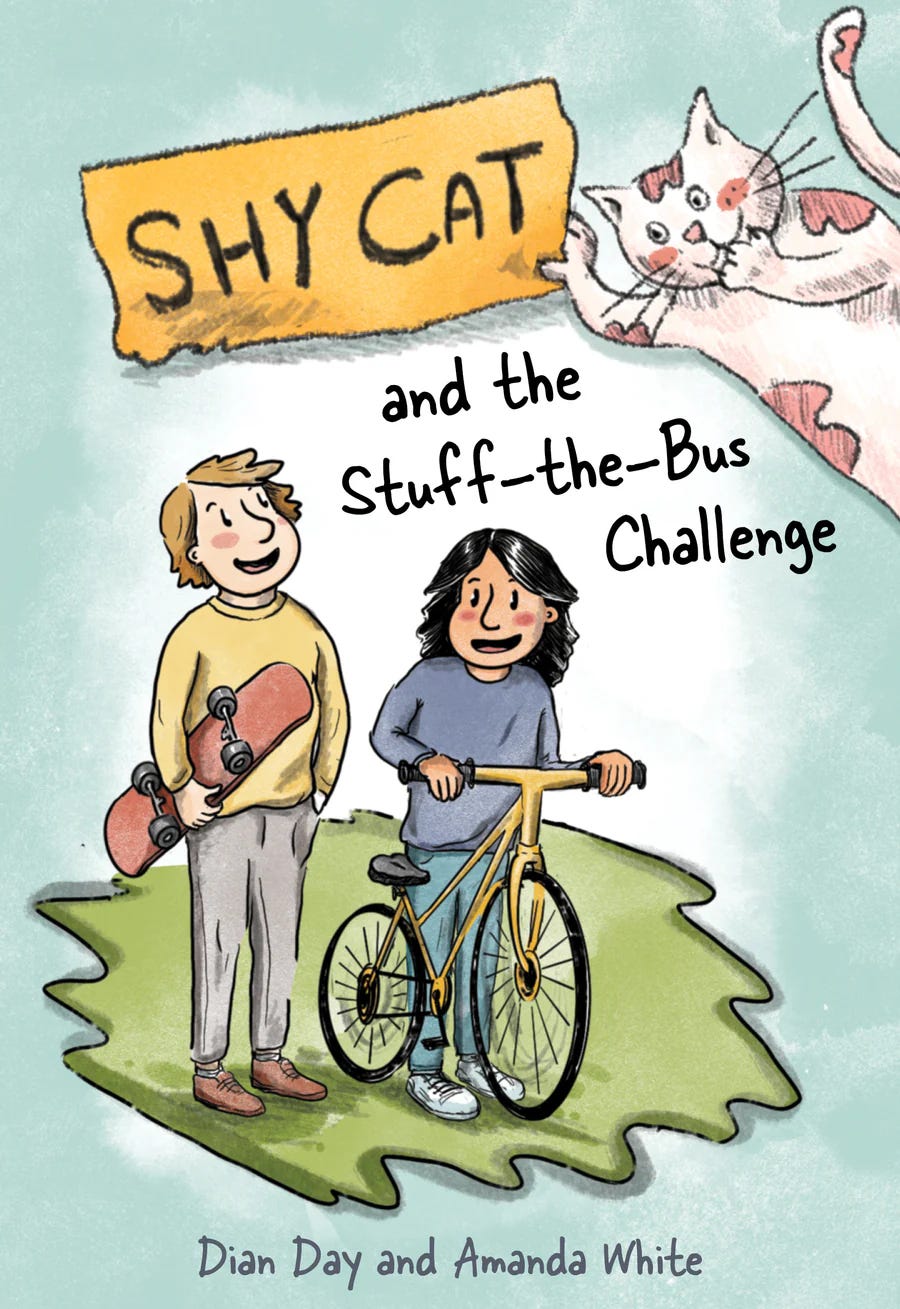
Dian Day is the author of two novels, The Clock of Heaven, and The Madrigal, both of which I enjoyed reading. She then appeared to stop writing for a while (the interview below explains why), but she has since returned, this time with Shy Cat and the Stuff-the-Bus Challenge a graphic novel for younger readers rather than an adult novel. Naturally, I was interested in seeing how Ms. Day would handle a book for young readers, even though I don't have any kids.
“Shy Cat” (the book’s feline protagonist) is a cartoon creation of Mila, a pre-teen girl who loves to sketch a comic on any piece of paper she finds. It is also a way for her to visualize solutions to problems she doesn’t quite understand, such as food insecurity, the subject of this graphic novel. Mila’s best friend Kit is the child of a single mother who has a job and is just making ends meet. As such, there is not a lot of food in the house, and Kit is always hungry, always thinking of food.
At Mila and Kit’s school, a “Stuff-the-Bus Challenge” is being held to support the local food bank. The class that contributes the most will get a pizza party, which gets everyone involved, even Kit. One day, Kit notices in the donation box a rusty, dented can and other items past their “best before” date and has a meltdown and runs away from school. (Spoiler alert: he is found safe)
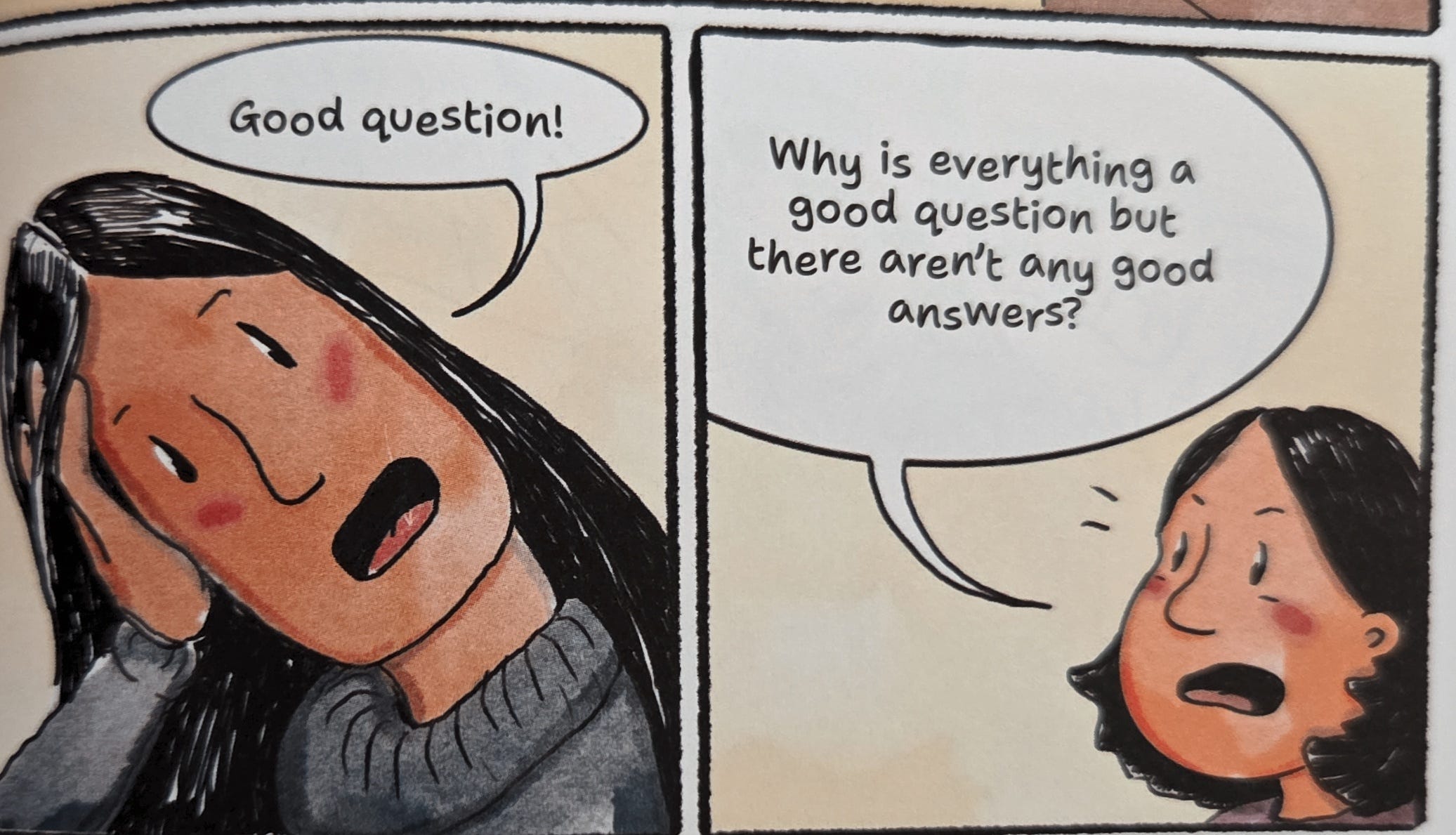
This causes Mila to ask her mother about why Kit had this reaction, why there isn’t enough food for everyone, and so on. All good questions, and difficult for her mother to explain. “It’s complicated” is an oft-repeated answer, which is no answer.
A second storyline has a friendly stray cat that Mila cannot adopt as her mother is allergic, but she tries to get a downstairs neighbour to adopt it, despite her aversion to cats. This provides a little relief from the weightier matters in Mila’s and Kit’s everyday lives. One worries about food, the other about the issues of the day, particularly food insecurity.


What I liked about this graphic novel is that it doesn’t speak down to young people, or make parents cartoonish. Another thing I appreciated is that it is “real world” in that there’s no magic involved, solutions aren’t easy, and food banks are not the solution, just to name a few. I found myself opening the book and flipping through the images again and again.
Maybe it’s because of the cat?
I also wanted to catch up with Dian Day and find out more about how Shy Cat came to be.
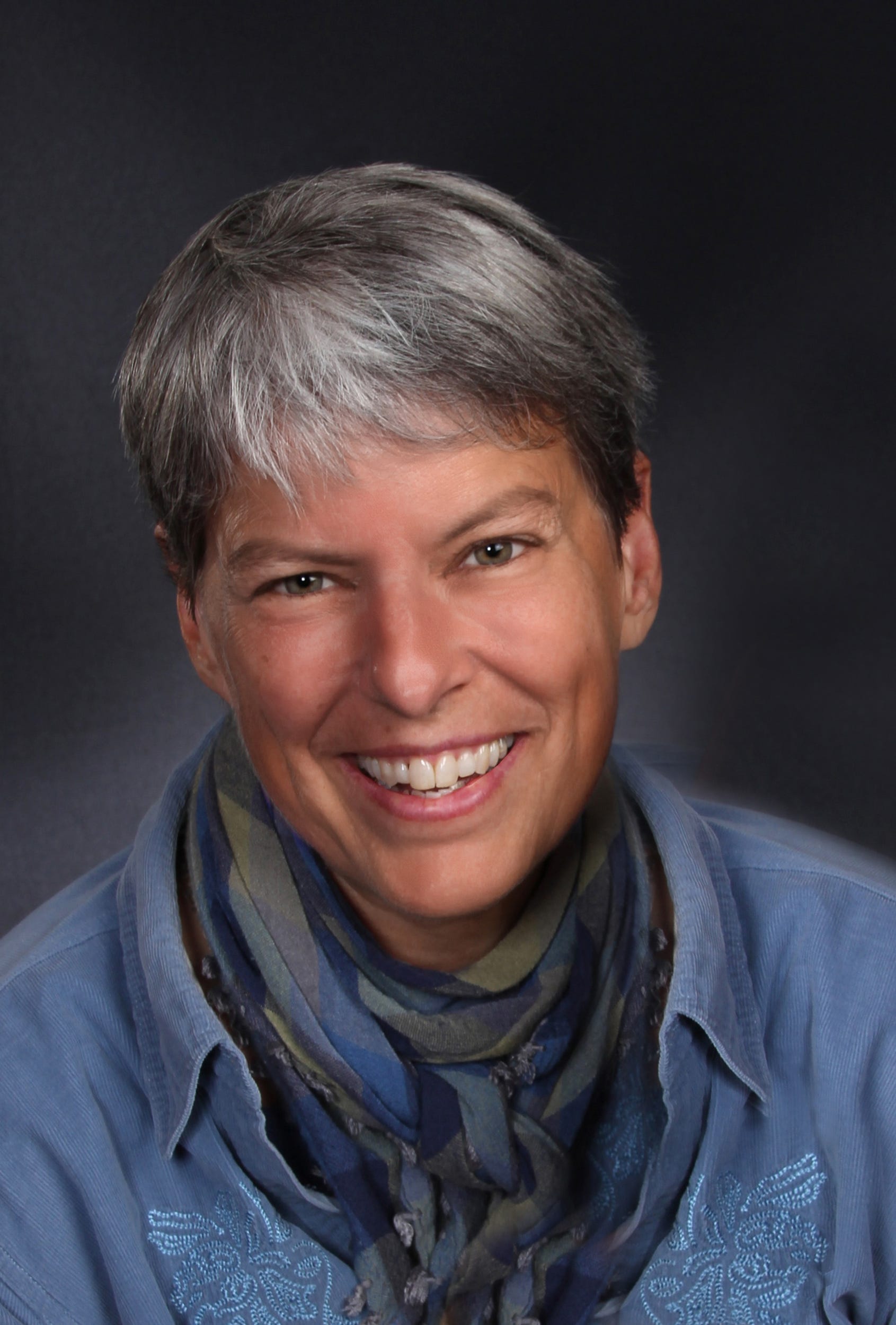
Dian, you have authored two acclaimed novels for adults, what made you turn your attention to a younger crowd with Shy Cat?
This is a long and complicated story! I’ll try to summarize:
There was a small group of food and anti-poverty activists/academics who’d started meeting, just before the pandemic, to try to figure out how to communicate effectively about food insecurity with kids. They’d been on the lookout for books and other resources that didn’t suggest that food banks could solve the problem (because they can’t) but couldn’t find what they were looking for. I’d more or less abandoned my own previous doctoral work at that point, but I knew one of them, and she asked me to join the group. They thought it might be useful to have a writer on board, and by (lucky!) happenstance that ended up being me.
We started calling ourselves the Hungry Stories team and met every few months by Zoom—we’re spread right across the country—and we were just hanging out together talking about the issue and still looking for resources. At some point, we knew we had to be more systematic about that search, and I decided to take that on; all that work eventually led to me finishing my doctoral degree with a new topic: Food insecurity in children’s literature. And after you’ve written 200 pages about the limitations of much of that literature, what’s left except to actually write the book that tackles the subject in a way that we could endorse?
The strange thing is that I wrote several kids’ books—both middle grade novels and picture books—long before I wrote the adult novels, but they weren’t picked up. So in a way, this book has brought me back to my writing origins.
“ I mostly wanted to communicate the complexity of the food insecurity problem, and to let kids know that even adults have a hard time figuring out how to solve it.”
What was the inspiration for this book? Was it an actual cat? A Stuff-the-Bus challenge that was held locally?
Inspiration…. Hmmm. I think much of it arose more from knowing what I didn’t want to write—having read quite a few really problematic (and, to be fair, several excellent) books about kids and poverty. I mostly wanted to communicate the complexity of the food insecurity problem, and to let kids know that even adults have a hard time figuring out how to solve it. The child of one of the Hungry Stories Team members did have a stuff-the-bus challenge at their school, so we talked about that quite a bit as a group. The scene with Kit and the bananas comes directly from my own experience, many years ago, of having a hungry little boy visit my house. And the idea for Mila’s interest in comics came from one of my grandkids, who for a while was always drawing funny little scenes—though not of cats! So all the bits and pieces just came together in the way that any work of fiction does; some very small fragments are based on real life experiences, put together with that mysterious thing that happens when you sit down to write, and suddenly there’s a whole world.
How different is it to create a graphical novel vs an all-text novel? What was it like working with an artist like Amanda White?
It is totally different. As soon as the book turned into a graphic novel, I asked Amanda to join the group to handle the art; we’d met at university a few years before and had become good friends. To be honest, when we began, neither of us had any idea what we were doing. I would sketch some scenes and write the words, and then Amanda would re-interpret everything. We did take a graphic novel course together (online) at OCADU, where, two years into the project, we learned that people usually write scripts for graphic novels! Who knew? So then I went back and wrote a script, and left the art to Amanda. It was a very long process; it’s a good thing we didn’t know how long it would take when we started.
Were there compromises to be made, like Kit and Mila do over colours and such in Shy Cat?
It doesn’t feel like there were “compromises.” It feels more like we just talked about things, and talked about things, and talked about things, until we both agreed. We talked pretty much every day for almost two years while we were actively working on it. The collaboration was a real joy and a real gift. And we are still good friends!
One thing I appreciated about the story is that you didn’t exclude the adults from the picture. Mila’s mother sometimes has difficulty answering her questions (“it’s complicated”) and Kit’s mother works at a low-paying job, etc. In that sense, it will make for good conversations between parents and children.
I’m glad you appreciated that part. It was actually one of the things that was most important to me in writing the book. There are far too many of what I call ‘dead, disappeared, and disempowered’ parents in kids’ books. What weird message are kids getting from that? I wanted to write about kids and parents who loved and respected each other because, frankly, that’s what we want in the world! I think it was especially important to show Kit’s mom as both loving and hard-working because so much of the literature about food insecurity makes it the parent’s fault, when it’s largely a structural and policy problem.
Will there be more “Shy Cat” books?
Yes! The next one is entitled Shy Cat and the Museum of Lost Plastic.
One other thing that’s been confirmed is a picture book, Mama’s Stories, with artist Ann Siddall, coming out with Second Story Press next year, also featuring a child living in poverty.
I’m also currently working on another adult novel, Reason, and a YA novel, Air Holes.
About the Author & Artist
Dian Day is an award-winning writer, with two novels for adults, The Clock of Heaven and The Madrigal. She is a member of the Hungry Stories Team, a cross-Canada collaboration of food scholars and activists. She and her partner live in Antigonish, Nova Scotia.
Amanda White is a multi-disciplinary artist who writes, teaches, and makes art about the environment, sustainability, and climate. She is a member of the Hungry Stories Team. Originally from Toronto, she now lives in Vancouver with her family, where she is an assistant professor at Emily Carr University of Art and Design.
Book Details
Publisher : Second Story Press
Publication date : March 3 2026
Language : English
Print length : 208 pages
ISBN-10 : 1772604453
ISBN-13 : 978-1772604450