

Thomas Becket: Medieval Antifa
For resisting tyranny, the archbishop was murdered —but his example of resistance lives on

We do not know very much of the future

Except that from generation to generation

The same things happen again and again.
––T.S. Eliot, Murder in the Cathedral
Recently, the U.S. government designated Antifa, the worldwide anti-fascist movement, as a terrorist organization. Problem: there’s no “a” about Antifa. Its members are autonomous groups and individuals.
You can eliminate one in the short term, certainly. But, with Antifa’s centuries-old tradition of protesting tyranny, more will appear.
Take Thomas Becket (1118-1170), who I’d argue was an early Antifa. It’s been almost a century since four knights, at the behest of King Henry II, stabbed the archbishop to death on the altar of Canterbury Cathedral. Yet, Becket continues to inspire us.
Not that Becket, born to a middle-class family in London, set out to become a saint, as happened after his murder when Pope Alexander III canonized him. On the contrary, as a student in Paris, then administrator at Henry’s court and eventually chancellor, Becket was a boisterous, athletic carouser. Henry prized him both as a companion and an effective writer and speaker.
In Jean Anouilh’s Becket, the king’s attraction to Becket is rather more. In the movie version, Henry, played by a scenery-chomping Peter O’Toole, wrathfully informs Queen Eleanor that she’s never been a true wife to him. “No one on this Earth has ever loved me, except Becket!”
Becket reluctantly agreed to Henry’s appointing him archbishop of Canterbury. Then, enraging Henry, he fought the king’s attempt to control the church. For example, Henry wanted to make clerics charged with crime subject to secular, not canon, law. He also appropriated some religious properties and gave them to friends.
Woe to a tyrant whose foe is a reader. Among the scholars Becket studied was John of Salisbury. As biographer John Guy notes in Thomas Becket: Warrior, Priest, Rebel, Salisbury’s work is considered the first complete medieval work of political theory. A good pastor, Salisbury maintained, should resist a wicked ruler.
I’ve mentioned O’Toole’s scenery-chomping performance as Henry II. Appropriate, as it turns out, because in his tantrums at Becket, the real Henry would cram straw from the floor into his mouth and, yes, chomp on it.
Becket’s response: “… although the world rages, the enemy rises, the body quivers, and the flesh is weak, I shall, God willing, never give in shamefully or commit the offence of abandoning the flock that is entrusted to me.” Like Antifa, he understood that theatrics empower resistance. When Henry demanded all priests’ support—blindness and castration being the alternative—Becket conducted a dramatic public Mass in honour of St. Stephen, the first Christian martyr.
The archbishop’s popularity swelled. Wherever he went, crowds cheered. Out-manoeuvred, not to mention out-theatred, Henry infamously pleaded for someone to rid him of Thomas. Enter the four knights, whose slaying of Thomas, Guy says, was not the misunderstanding Henry later claimed.
As T.S. Eliot observes in Murder in the Cathedral, tyranny is nothing new. Nor, thankfully, is resistance. Canterbury Cathedral archivist Cressida Williams says Becket’s story “still speak(s) to us today… of standing up for what we feel is right, standing up against power which we feel is unjust and, in Becket’s case, making a huge sacrifice for what we believe in.”
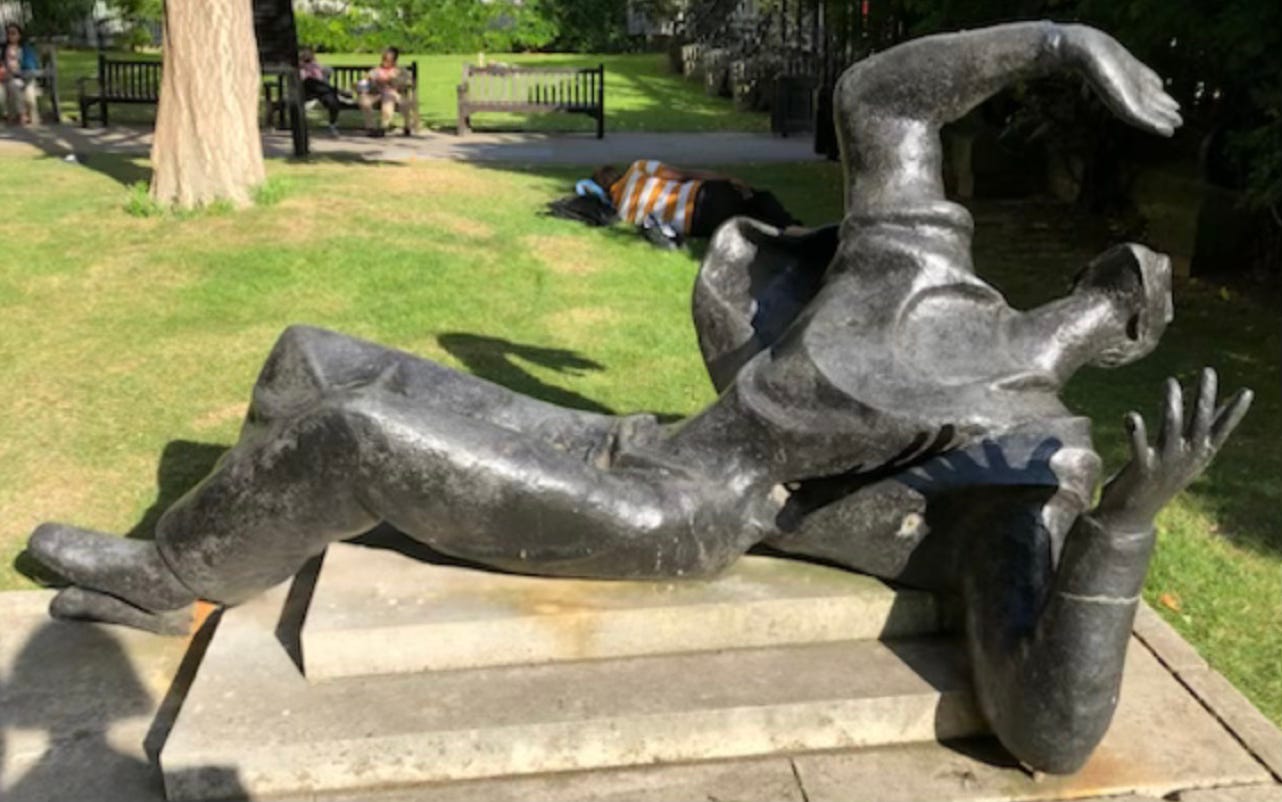
I recommend Guy’s biography of Becket. Also the literary takes by Eliot and Anouilh. But my favourite depiction of Becket is the 1970 Edward Bainbridge Copnall sculpture in St. Paul’s Churchyard, London. Shown as the knights are about to strike, Becket is either looking up at them and holding out his arms to shield himself—or looking up to heaven, reaching for God.
Or both.
About the Authors
Internationally renowned playwright Jean Anouilh (1910-1987) gained fame and acclaim for including such techniques in his dramas as the play within the play, flashbacks and flash forwards, and the exchange of roles.
American-English writer, critic, and editor T.S. Eliot (1888-1965) led the modernist poetry movement. Eliot’s innovations in diction, style, and verse can be found in such poems The Waste Land (1922) and Four Quartets (1943).
Born in 1949, John Guy studied history, making his his public début as a presenter on the life of Thomas More for the BBC television program Timewatch. In 2004 Guy won the Whitbread Prize for his biography Queen of Scots: The True Life of Mary Stuart.
About the Reviewer
Melanie Jackson is a Vancouver freelance writer/editor. She’s also the award-winning author of middle-grade/YA suspensers, including Orca Books’ Dinah Galloway Mystery Series, and several chillers set in amusement parks. Visit Melanie’s page at The Writers’ Union of Canada site.
Book Details
Becket, by Jean Anouilh
Publisher: Riverhead Books, September 1, 1995
Language: English
Paperback: 144 pages
ISBN: 978-1573225083
Murder in the Cathedral, by T.S. Eliot
Publisher: Mariner Books, March 18, 1964
Language: English
Paperback: 96 pages
ISBN: 978-0156632775
Thomas Becket: Warrior, Priest, Rebel, by John Guy
Publisher: Random House, July 3, 2012
Language: English
Hardcover: 448 pages
ISBN: 9780679603412